










































































A custom designed box starts with the packed product. It has to hold the item, close in the intended order, present the right panel, and survive the route to the customer. A flat screen will not show type sitting over a score or an insert leaving too much room.
What does a custom box need to get right?
The inside cavity sets the box's starting point. Measure the product at its widest points, then account for an insert, wrap, lid, or component set before the outside panels are drawn. State length x width x depth, and label each measurement as inside or outside. A mailer going through parcel handling needs different wall and closure decisions than a folding carton loaded by hand.
Which structure fits the opening and packing method?
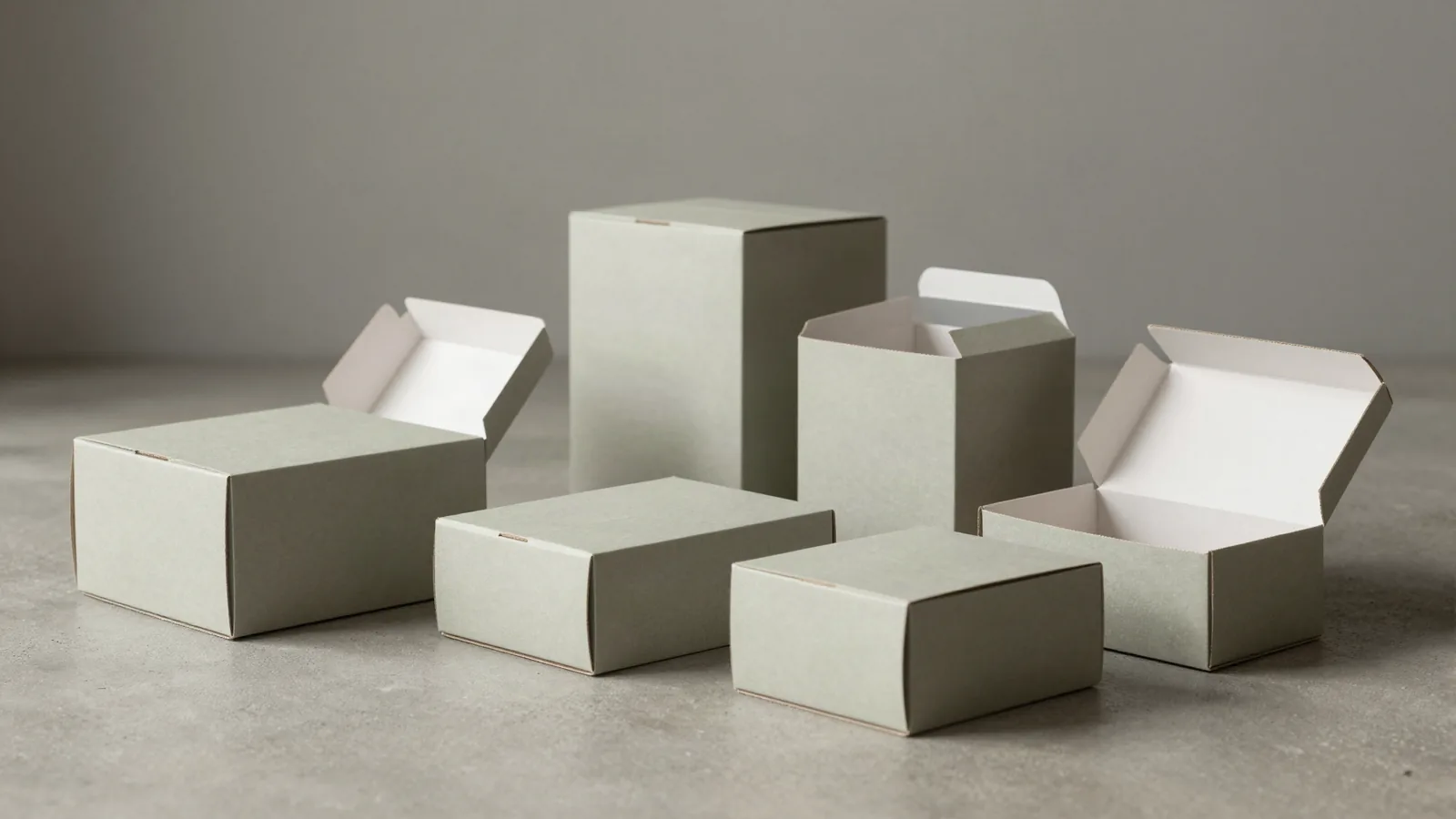
Straight tuck end and reverse tuck end change the direction of the closing flaps, so panel order comes before artwork. Auto-lock bottom and crash-lock bottoms change how the base forms during packing. A roll end tuck top mailer carries its lid on the parcel shell, while a two-piece rigid box separates lid and base.
| Structure | Common use | Check before artwork |
|---|---|---|
| Straight tuck end | Folding carton closure | Front panel and opening tab |
| Reverse tuck end | Different top and bottom flap sequence | Loading direction and panel order |
| Auto-lock bottom | Base that forms during setup | Squaring and loading motion |
| Roll end tuck top mailer | Parcel carton with an attached closing top | Lid, front, and side-wall alignment |
| Two-piece rigid | Separate lid and base | Lid reveal and inside support |
Sleeves, drawer or slide boxes, magnetic flaps, gable boxes, and pillow boxes change the opening and loading motion. Compare custom woozy bottle boxes, custom votive candle boxes, custom vial boxes, and custom tuck top mailer boxes when product shape drives the panel layout.
Which board should I put on the dieline?
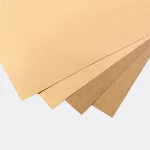
Paperboard gives a folding carton a flat printed surface, while corrugated board adds a fluted layer between liners. A flute is the wave-shaped paper layer that adds thickness and stacking strength. SBS, C1S, and C2S paperboard are commonly discussed in the 12 to 24 pt range. Kraft board is commonly discussed in the 18 to 24 pt range.
| Material | Typical industry reference | Design consequence |
|---|---|---|
| SBS, C1S, or C2S paperboard | 12 to 24 pt | Printed folding panels and scored folds |
| Kraft board | 18 to 24 pt | Natural-looking surface and firm folds |
| Rigid chipboard | 1.5 to 3 mm, wrapped in 100 to 157 gsm art paper | Stiff lid, base, drawer, or slide |
| Corrugated board | E, B, or C flutes, with 32 ECT as a common strength convention | Shipping-oriented walls and stacking |
ECT means edge crush test, a standard strength reference for corrugated board. Board choice changes score behavior, flat storage, color, and hand feel, so confirm board and structure together.
How do I prepare the dieline for artwork?
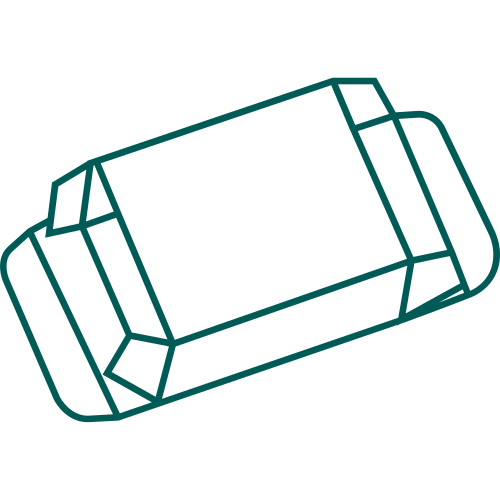
A dieline is the flat cutting template that shows cut lines, scores, glue tabs, panel order, and insert geometry. It is drawn from inside product dimensions. About 1/16 in, or 1.5 mm, is a common planning tolerance, but board caliper, scoring, compression, and product shape determine the actual fit.
Leave bleed beyond the cut line. As a standard prepress reference, 0.125 in, or 3 mm, is common. Keep type and barcodes clear of scores, glue areas, and folds. Low-resolution art can look soft on a large panel, and RGB art can shift when converted for press. An insert cut to the exact product size can make the product rattle if the actual fit needs clearance.
Which print and finish should I specify?
Digital print suits short runs and versioned graphics. Offset CMYK is common for detailed folding-carton panels, and flexo is typical on corrugated. The print method should match the board, ink coverage, quantity, and finish.
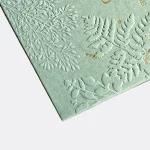
Matte lamination reduces reflection, while gloss lamination increases shine. Soft-touch changes surface feel. Spot UV adds selective gloss. Foil stamping adds reflective detail. Embossing raises the board and debossing presses it in. Map these effects around scores, glue tabs, and small type.
What should I check before the box goes to print?
A press check looks at ink coverage, registration, scores, glue tabs, and finish placement. Assemble the sample with the actual product. Test the closure, check the insert, and stack several empty boxes if the package will be packed into a master carton.
Check the digital proof before anything prints. Look for type too close to a score, missing bleed, a barcode too small to scan, or artwork on the wrong panel. These are cheap corrections before production.
How do I request a box quote?
A quote is easiest to compare when it names the inside dimensions, board, structure, print method, finish, insert, quantity, and destination. Cost also moves with board caliper, print coverage, finishing, quantity breaks, tooling, insert complexity, and shipping zone. Custom Packaging Lane quotes from a 100-unit minimum. Pricing is from $0.49 per unit at volume, quoted to spec. Production is typically 8 to 10 business days after proof approval, plus delivery. Free US shipping, free design support, and a free dieline are available. The $19.99 sample kit is credited to the first order. Use the custom packaging design hub to organize the brief.
Frequently Asked Questions
What measurements should I send for a designed box?
Send inside length, width, and depth for the packed product, plus its widest points, inserts, wraps, lids, and component sets. State the product orientation and the way the box will close. A box drawn from outside measurements can steal clearance from the product, so label every dimension as inside or outside before the dieline is drawn.
What is the difference between a tuck carton and a mailer?
A tuck carton closes with folding flaps attached to the carton panels. A mailer keeps its closing top connected to the parcel shell and often uses a stronger shipping-oriented structure. Straight tuck end, reverse tuck end, and roll end tuck top mailer formats each change the opening direction, loading motion, and artwork panel map.
What does 32 ECT mean on a corrugated box?
32 ECT means 32 edge crush test, a standard corrugated strength reference. ECT describes the force needed to crush an edge of the board under a test method. It is one planning input alongside flute, box dimensions, scores, closure, and stacking conditions. Confirm the selected board in the written specification.
Why do RGB files change in packaging print?
RGB files describe color with light-based red, green, and blue channels, while press artwork is prepared for an ink process. Conversion can change saturated colors, especially across broad panels. Check the converted artwork on the proof, then inspect large color fields, small type, images, and any finish layer before approval.
Can a custom box have a rigid lid and base?
Yes. A two-piece rigid box uses a separate lid and base built around rigid chipboard, commonly 1.5 to 3 mm, wrapped in printed paper. The dieline and sample should establish the lid reveal, inside support, product clearance, and the way the lid comes off. The structure is different from a folding tuck carton.