




























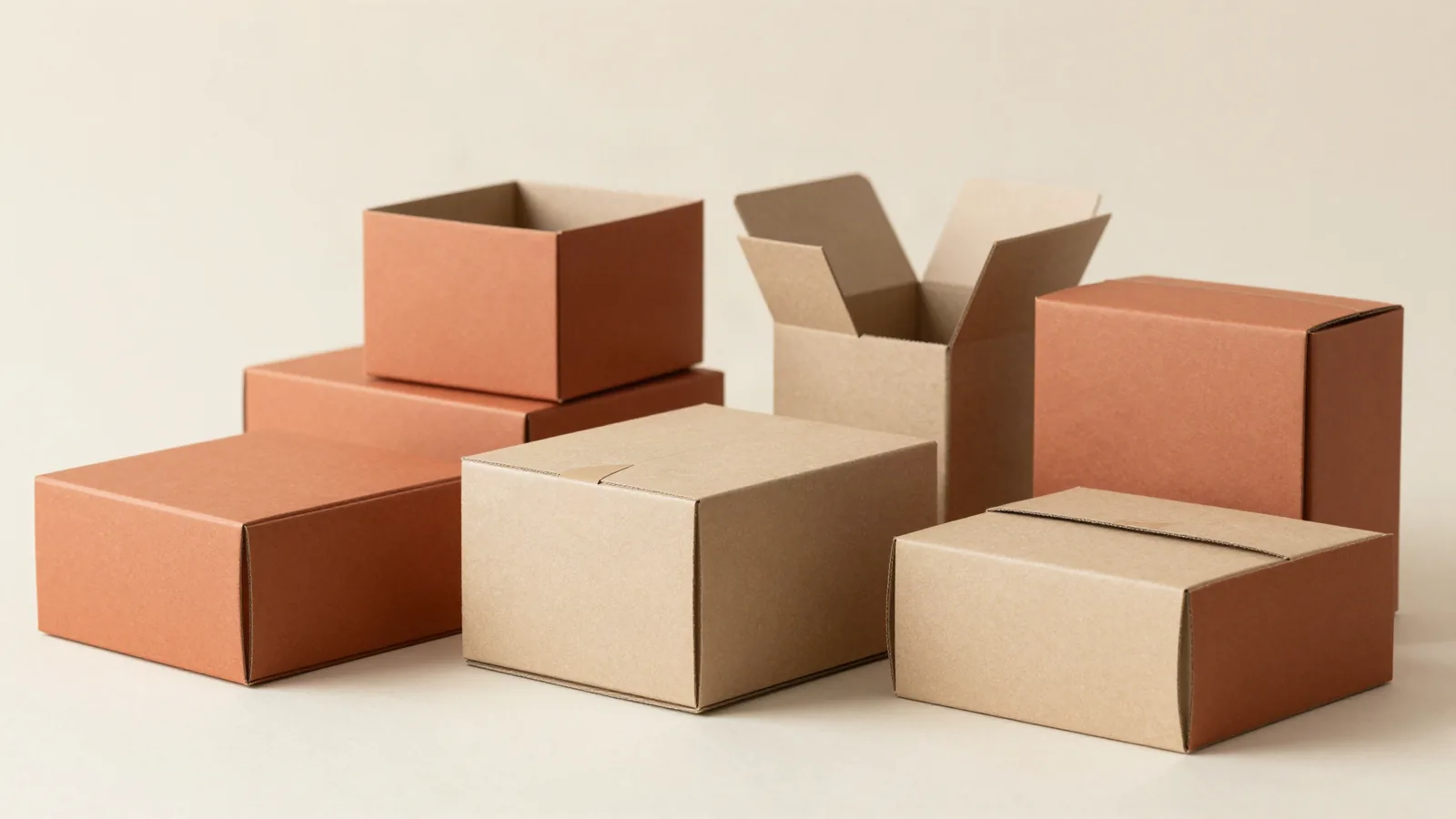




















































Custom designed packaging connects the product cavity, opening, panel order, and delivery format. The route to the customer can call for a folding carton, mailer, rigid box, sleeve, or insert.
What goes into a custom packaging brief?
The packed product and the first hand movement belong at the top of the brief. Name the product, packed contents, inside measurements, opening sequence, intended channel, artwork coverage, material direction, finish, insert or window needs, quantity, and destination. If the package sits on a shelf, identify the first visible panel. If it ships directly, describe the outside pack and closing behavior.
State length x width x depth as inside or outside measurements. Measure the widest points, wraps, lids, and component sets. About 1/16 in, or 1.5 mm, is a common planning tolerance, but final fit depends on caliper, scoring, compression, and product shape.
Which packaging structure matches the product experience?
A straight tuck end uses folding flaps, while a drawer or slide pulls a tray from an outer sleeve. That difference changes the loading motion and the first panel a customer sees.
| Design direction | Common structure | Physical question |
|---|---|---|
| Printed carton | Straight tuck end or reverse tuck end | Which panel carries the first message? |
| Rigid presentation | Two-piece rigid or magnetic flap | Does the lid and base justify the extra build? |
| Layered reveal | Drawer or slide with an outer sleeve | Where does the tray stop and pull? |
| Visible product | Carton with PET window patch | What remains visible after loading? |
| Direct parcel format | Mailer, gable, or pillow structure | How will the package close and travel? |
Auto-lock bottom and crash-lock bottom structures form the base during setup. Mailer, gable, and pillow structures change the packing motion.
How do materials change the design decision?
A 12 to 24 pt paperboard carton folds flat, while 1.5 to 3 mm chipboard holds a rigid shape. SBS, C1S, and C2S paperboard are common references for printed cartons. Kraft board is commonly discussed in the 18 to 24 pt range. Rigid chipboard is commonly wrapped in 100 to 157 gsm art paper.
| Material | Typical industry reference | Planning use |
|---|---|---|
| SBS, C1S, or C2S paperboard | 12 to 24 pt | Printed folding cartons |
| Kraft board | 18 to 24 pt | Natural-looking cartons and sleeves |
| Rigid chipboard | 1.5 to 3 mm, wrapped in 100 to 157 gsm art paper | Two-piece rigid, drawer, or magnetic flap |
| Corrugated board | E, B, or C flutes, with 32 ECT commonly discussed for strength | Shipping-oriented outer packaging |
A flute is the wave-shaped layer inside corrugated board. E, B, and C flutes change thickness and stacking. 32 ECT is a common strength convention, but the finished structure still needs checking.
When should a package use a window or insert?
A window shows a product before opening, while an insert fixes its position inside the box. PET film around 0.2 to 0.3 mm is a common reference for a window patch. The window changes the cut line and seam area. The insert consumes cavity space and can change how the product is lifted.
Draw both parts with the outer structure. A window across a fold can distort. An exact-size insert can let the product rattle once actual clearance is accounted for.
Use custom tin packaging for a decorated metal direction, custom taper candle packaging for length and internal-support questions, and custom stevia packaging for a compact carton reference.
Which print and finish choices support the artwork?
Offset CMYK puts detailed graphics on folding cartons, while digital print can suit shorter runs or version testing. Flexo is commonly associated with corrugated print. Matte or gloss lamination changes reflection. Soft-touch changes the hand feel. Spot UV, foil stamping, embossing, and debossing add selective surface detail.
Put each treatment on the dieline. Keep finishes away from folds, seams, glue zones, windows, and small type unless the production specification calls for that placement. Low-resolution art can soften on a broad panel, and RGB art can shift during conversion for press.
What should I check before approving the design?
The assembled sample is the deciding check for fit, closure, and movement. Compare the flat cutting template, printed proof, and folded package. Confirm panel order, artwork-safe areas, bleed, folds, glue zones, insert movement, window placement, closure, product orientation, and outside pack dimensions.
A digital proof catches a wrong barcode position or a headline on the back panel before anything prints. Load the actual product and check the clearance around the lid, insert, or window.
Which catalog products can anchor the design brief?
Use custom screw packaging and custom scissor packaging for shaped-product planning. Custom printed macaron packaging boxes can frame window, cavity, and presentation questions. For flat contents, inspect custom greeting card packaging. For a larger protected item, compare custom drone packaging boxes.
How do I start a packaging quote?
A quote request should name the product, inside dimensions, structure, board, print method, finish, insert or window, quantity, and destination. Custom Packaging Lane works from a 100-unit minimum. Pricing is from $0.49 per unit at volume, quoted to spec. Production is typically 8 to 10 business days after proof approval, plus delivery. Free US shipping, free design support, and a free dieline are available. The $19.99 sample kit is credited to the first order. Use the custom packaging design hub when the structure and artwork brief are ready.
Frequently Asked Questions
Does a packaging brief start with artwork or product dimensions?
Product dimensions come first because they set the cavity, panel size, closure clearance, and insert space. Send inside length, width, and depth, then add the packed contents, opening sequence, board direction, artwork status, finish, destination, and any window or insert. Artwork can then be placed on a structure that matches the product.
What is a PET window patch?
A PET window patch is a clear film panel attached behind a cut opening in the package. PET film around 0.2 to 0.3 mm is a common reference. The patch changes the cut line, seam area, and artwork map, so draw it with the box structure and keep it clear of folds and glue zones.
How does a drawer box open?
A drawer box uses a tray that slides through an outer sleeve. The tray stop, pull area, cavity, and sleeve artwork need to be planned together. Product length, insert clearance, and the amount of tray exposed at full pull affect the opening motion. A flat artwork file cannot show those relationships by itself.
What should a packaging sample prove?
A packaging sample should prove the product fit, closure action, panel order, insert position, window placement, and surface feel. Load the actual product and operate the package as a customer would. A sample can expose a lid clash, loose insert, wrong opening edge, or score placed through an important line of type.
Should the printed design cover every panel?
No. A package can use quiet areas around folds, glue zones, barcodes, windows, and opening edges. Full ink coverage can also change how a board crease looks. Map the reading order first, then decide where color fields, copy, finish layers, and unprinted working areas belong on the finished structure.












