
























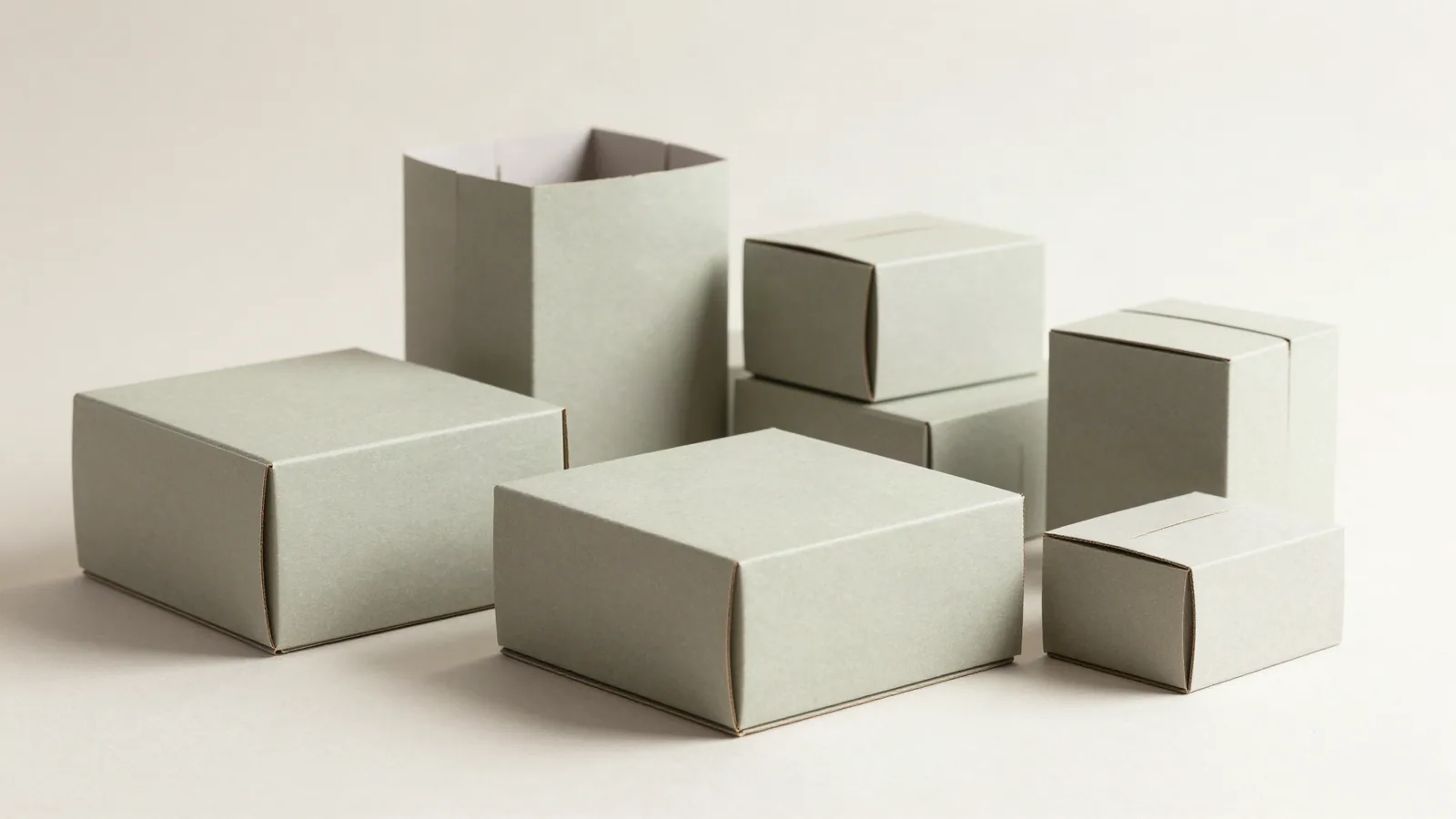
















































Custom foldable boxes ship flat and form around a product through scored panels, tabs, folds, and a closure. The specification combines the board, finished dimensions, opening, artwork area, and shipping role. A folding carton for shelf presentation has a different job from a corrugated mailer that travels through a carrier network. Compare custom tuck top mailer boxes, custom vial boxes, and custom votive candle boxes as format references. A dieline is the flat cutting and creasing template used to print and cut the package.
Which foldable box structure fits the product?
The opening direction decides the first comparison. A straight tuck end keeps the tuck panel on the same side as the main front panel, while a reverse tuck end changes the closing direction. An auto-lock bottom forms through folding, and a crash-lock bottom uses a pre-glued base that opens into shape.
| Structure | Common planning use | Question to answer |
|---|---|---|
| Straight tuck end | Folding carton with a familiar top closure | Which panel is the front, and where does the tuck land? |
| Reverse tuck end | Carton with alternate top and bottom fold directions | How should the opening align with the artwork? |
| Auto-lock bottom | Foldable carton with a self-forming base | What product weight and hand-setup motion are involved? |
| Crash-lock bottom | Pre-glued base that opens into shape | Where should the base folds and closure pressure sit? |
State whether the box is hand-filled, machine-filled, displayed upright, or placed inside another shipper. The box should arrive, open, hold the product, and close in the same sequence used at packing.
What board should I compare for a folding carton?
Board caliper changes stiffness, crease behavior, edge feel, and how formed panels hold their shape. Common paperboard references include SBS, C1S, and C2S in the 12 to 24 pt range. Kraft board is another reference around 18 to 24 pt when the surface and stiffness need to change.
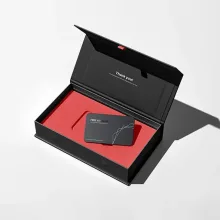
Rigid chipboard is a separate construction, commonly around 1.5 to 3 mm and wrapped in 100 to 157 gsm art paper. It holds shape without folding, so compare it when the brief calls for a fixed presentation structure rather than a flat-shipped folding carton.
How should I write the box dimensions?
Inside measurements make fit easier to check. Write each box as length x width x depth, then label every value as inside or outside. About 1/16 in, or 1.5 mm, is a common tolerance reference, but the applicable result depends on board, scores, folds, finishing, insert fit, and closure geometry.
Measure the product with its closure, wrap, liner, or insert in place. Include loading clearance, fold lines, glue areas, and panels that must remain unobstructed. A box can fit the loose product and fail once the actual packed unit is inside.
How does the fold pattern affect artwork?
The flat artwork must be read against the closed box, not only the unfolded sheet. Offset CMYK is commonly used for detailed paperboard artwork, while digital printing can suit a short run or an early artwork direction. Put the front panel, opening, folds, glue areas, dust flaps, and tuck panels on the proof in their closed relationship.
Matte or gloss lamination changes the visible surface. Soft-touch changes the feel, while spot UV, foil stamping, embossing, and debossing reserve contrast for selected details. Keep type away from scores and glue. Low-resolution art, RGB artwork converted for press, missing bleed, and copy placed too close to a score are prepress problems to catch before the run.
When should a foldable box become a mailer?
A carrier-bound package needs a shipping structure. A roll end tuck top mailer is commonly associated with FEFCO 0427, and corrugated E, B, and C flutes create different board profiles. 32 ECT is a common corrugated strength reference.
Use those terms as planning references, then confirm the filled package, inside fit, closure, void space, closed outside dimensions, and route. A shelf carton and a mailer may share printed panels, but their folds and board need to match different handling paths.
What should I send before requesting a dieline?
The request should include the product, insert, or a dependable product drawing, plus the finished structure and opening direction. Add dimensions, clearance, artwork panels, folds, seams, glue areas, tuck zones, finish locations, and the shipping role.
- Label length, width, depth, inside measurements, and outside measurements.
- Show the closure and display orientation.
- Mark folds, scores, seams, glue areas, and finish zones.
- Describe the product load and insert clearance.
- State whether the box is for shelf presentation, hand delivery, or carrier shipping.
How do I request custom foldable boxes?
Start with product measurements, opening direction, board direction, artwork status, and delivery destination through custom packaging design. Custom Packaging Lane quotes to spec from a 100-unit minimum, with pricing from $0.49 per unit at volume, quoted to spec. Production is typically 8 to 10 business days after proof approval, plus delivery. Free US shipping, free design support, and a free dieline are available. The $19.99 sample kit is credited to the first order.
Frequently Asked Questions
What are custom foldable boxes made from?
Custom foldable boxes commonly use SBS, C1S, or C2S paperboard in the 12 to 24 pt range. Kraft board is another reference around 18 to 24 pt. A fixed presentation package may use rigid chipboard around 1.5 to 3 mm wrapped in 100 to 157 gsm art paper. The board choice changes folding, stiffness, print, and fit.
How does a folding carton base change setup?
A straight tuck end or reverse tuck end changes the closing direction, while an auto-lock or crash-lock bottom changes how the base forms. Compare hand filling, machine filling, product weight, opening direction, base support, and display orientation. The chosen structure should match the way the box arrives, opens, holds the product, and closes.
What does an inside measurement mean on a folding carton?
An inside measurement describes the usable space within the formed box, before the product is loaded. Write the box as length x width x depth and label each value as inside or outside. About 1/16 in, or 1.5 mm, is a common tolerance reference, but board, folds, finishing, inserts, and closure geometry still affect fit.
Can foldable boxes be used for shipping?
A foldable box can be used for shipping when its board, structure, product fit, closure, and outer protection match the delivery route. A roll end tuck top mailer and FEFCO 0427 are common mailer references, while E, B, and C flutes describe corrugated profiles. Confirm the filled package, void space, and outside dimensions before choosing a shipper.
Which artwork details matter most?
Artwork for custom foldable boxes should keep logos and important copy clear of creases, glue areas, tuck panels, dust flaps, and covered surfaces. Offset CMYK is common for detailed paperboard print, while digital printing can suit short runs. Mark matte or gloss lamination, soft-touch, spot UV, foil stamping, embossing, and debossing as separate finish layers.