




























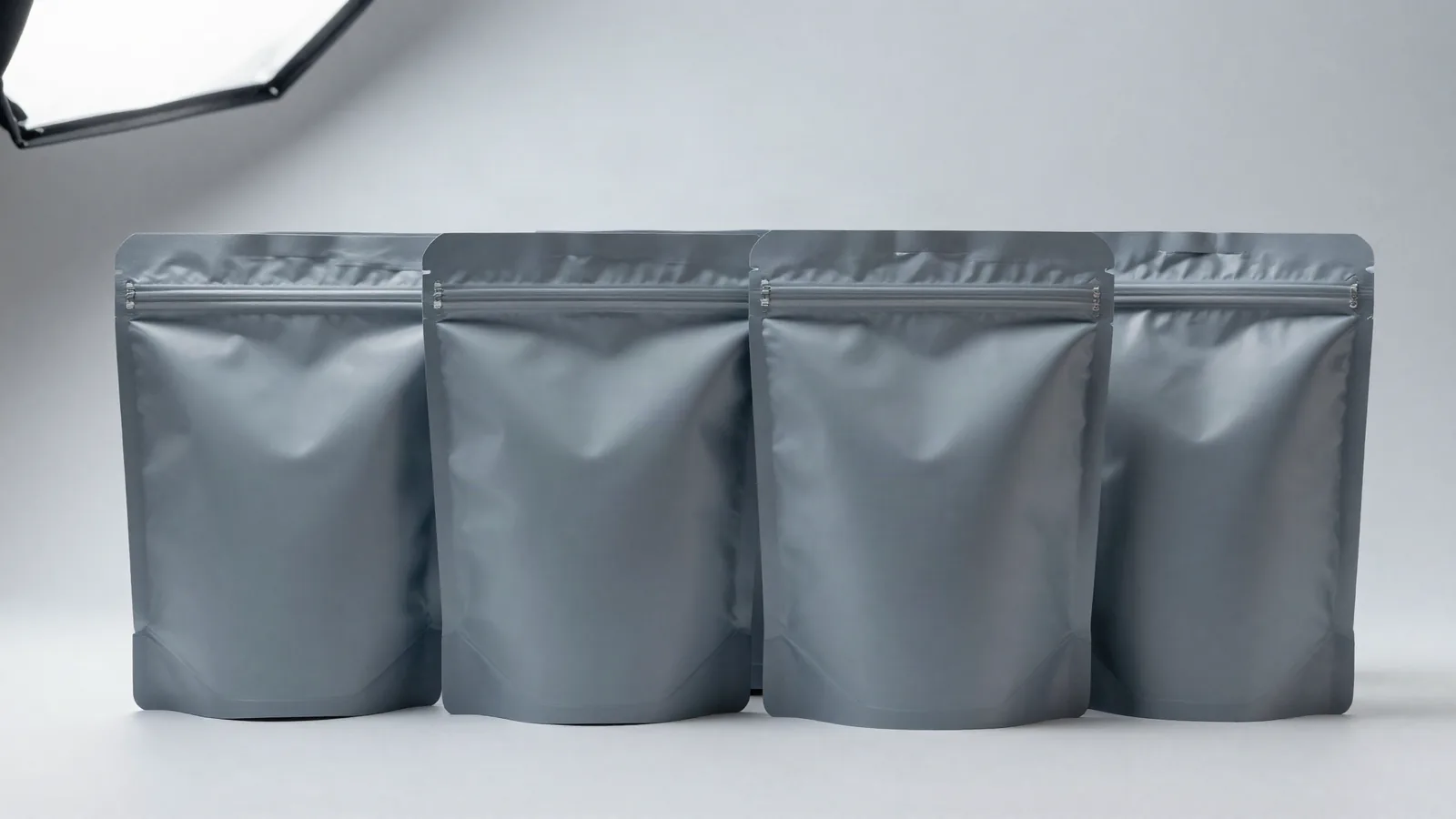




















































For a 1,000-unit pouch run, the count is easy. The hard part is describing how the pouch will be filled, sealed, opened, packed, and displayed. A dieline is the flat cutting template for artwork, film cuts, seals, folds, and tear features. Put product details beside the artwork before the quote.
What does a 1,000-unit pouch brief need?
The brief starts with the packed product, not the artwork file. Record product form, filled weight or count, finished width, height, gusset, storage position, opening behavior, and ship-to ZIP. State whether filling is by hand, on a line, or through a co-packer. The opening, headspace, seal area, and case pack follow that choice.
Write dimensions as width x height x gusset where relevant. Stand-up pouches commonly use a width range of about 3 to 7.5 inches, but the correct size comes from product shape and fill behavior. Measure a filled reference, not an empty pouch lying flat.
Which laminate and closure should I specify?
PET / AL / PE names a layered film build: polyester outer face, aluminum barrier layer, and polyethylene sealant layer. Mylar and foil laminate describe material directions that should appear in the request because film construction changes stiffness, opacity, seal behavior, and artwork appearance.
| Part of the brief | Reference to state | Why it changes the job |
|---|---|---|
| Film build | PET / AL / PE layers | Sets print face, barrier, and seal layer |
| Barrier direction | Mylar or foil laminate | Changes light protection and surface appearance |
| Closure | Heat seal, zipper, tear feature, or spout | Changes the opening and top clearance |
| Pouch body | Flat or stand-up with gusset | Changes the filled footprint and case pack |
Zippers need room above the fill; heat-sealed tops need a clean band. A tear feature changes the opening point, and a spout changes panel layout and filling. Put the closure on the proof, not in a separate email.
How does the filling method change the pouch?
A hand-filled pouch needs a different working opening from a line-filled pouch. A co-packer may need a consistent top edge and clear seal band. Keep headspace above the product, leave the seal area clear, and test for tipping, trapped product near the seal, and zipper access.
For a 1,000-unit run, say whether every pouch uses one artwork version or several approved versions share the count. List each version separately. Otherwise a simple total can hide several front panels, closures, or case labels.
Which print and finish details belong on the proof?
Offset CMYK suits detailed graphics; digital printing suits short runs or changing versions. Describe ink coverage, then state the logo placement. A full-color background uses more coverage than a small front-panel mark, and RGB artwork can shift when converted for press.
Show matte or gloss lamination and soft-touch separately. Spot UV is a cured gloss coating for selected areas. Mark foil stamping, embossing, and debossing as separate finish areas. A clear window is a construction decision, not an empty shape in the file. Keep type away from seals, zipper tracks, tear features, and window edges, then inspect the filled pouch.
How should 1,000 pouches be packed for delivery?
The filled pouch, not flat film, determines the master-carton plan. Confirm how many finished pouches fit in a shipping case, whether they nest or lie flat, and whether a divider or secondary carton is needed. Record case count and pallet count when the packed configuration is known.
For US ground planning, dimensional weight is commonly calculated as L x W x H / 139. Use outside packed dimensions, separate from inside fit. The ship-to ZIP belongs in the brief because delivery and production planning are separate questions.
Which pouch products can guide the brief?
Real catalog formats give the quote a clear starting point. Custom stand-up pouches point to a base that can sit on a shelf. Zipper pouches frame a reusable opening. give a category-specific reference, while herbal tea pouches show another flexible pouch direction. These are product references, not automatic dimensions for the 1,000-unit request.
If contents touch food, ask us about food-contact options for your product. Keep that question tied to contents, storage, and package surface.
What should I check before approving pouch artwork?
A filled physical check exposes mistakes a flat screen hides. Open the pouch at the intended tear or zipper point, fill it with the product or a representative substitute, and inspect the seal, gusset, front panel, and standing position. Check trapped product, zipper access, tipping, and whether the fill opening suits the packing method.
Check panel order, trim, safe areas, barcode placement, finish masks, and any clear window on the digital proof. If a barcode or small type sits beside a seal, move it before print. Keep approved construction, artwork, and product version together for replenishment.
What terms should I use for the quote?
The quote should repeat the finished pouch, version split, and ship-to detail. Custom Packaging Lane is a US-based packaging supplier. Projects are quoted to spec from a 100-unit minimum. Pricing is from $0.49 per unit at volume, quoted to spec. Production is typically 8 to 10 business days after proof approval, plus delivery. Free US shipping, free design support, and a free dieline cover the preparation stage. The $19.99 sample kit is credited to the first order. Start with wholesale custom packaging when the 1,000-unit request needs a purchasing path.
Frequently Asked Questions
What belongs in a 1,000-unit pouch quote?
A 1,000-unit pouch quote should name the product form, filled weight or count, width, height, gusset, laminate, closure, artwork version, fill method, case pack, and ship-to ZIP. State whether the pouch is flat or stand-up, and say how the finished units will nest or lie flat. Those details let the supplier assess fit and handling.
Why do PET, AL, and PE layers appear in a pouch specification?
PET, AL, and PE identify different layers in a pouch laminate. PET is the polyester outer film, AL is the aluminum barrier layer, and PE is the heat-seal layer. The layer order affects print face, opacity, light protection, stiffness, and sealing. Name the full structure instead of sending only a product category.
Does a zipper change the usable fill area?
A zipper changes the usable fill area because it needs headspace above the product and a clear track across the pouch. The zipper also changes how the user opens and recloses the package. Check the filled pouch for trapped product near the seal, difficult access, and enough room for the intended fill method.
What print problems should I catch on pouch artwork?
Pouch artwork should be checked for RGB color shifts after press conversion, type or barcodes too close to seals, missing bleed, incorrect panel order, and finish masks that cross a zipper or tear feature. Inspect the artwork on a folded or filled reference because a flat file cannot show every assembly mistake.
How should food-contact questions be handled for a pouch?
Food-contact questions should describe the contents, storage conditions, fill method, and package surface that touches the product. Ask us about food-contact options for your product before the laminate and seal are finalized. A pouch name alone does not answer the question, and the approved material discussion should stay tied to the actual use.












