




























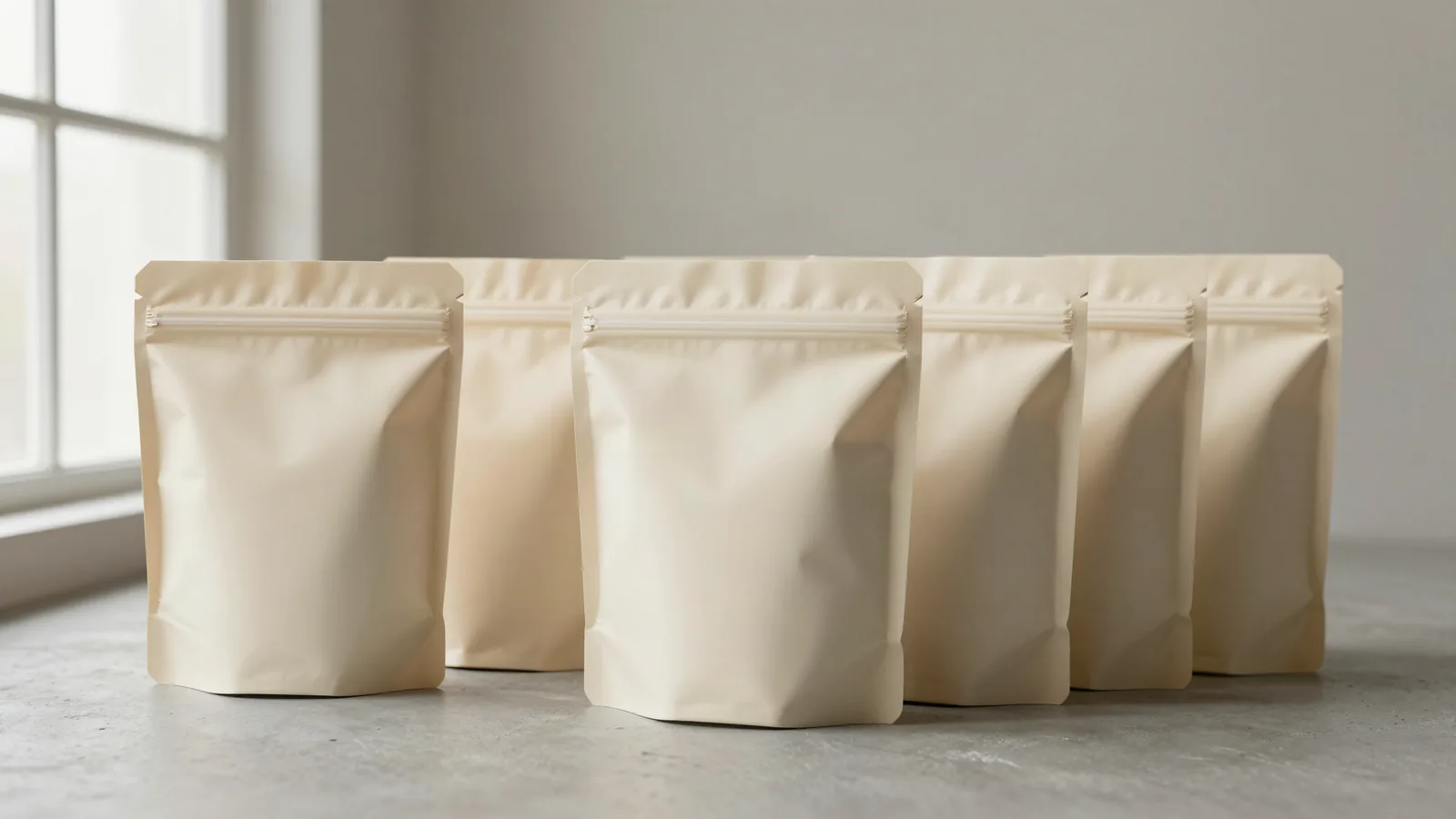




















































What dispensing task should a spouted pouch support?
The user action sets the pouch brief: pour, squeeze, refill, controlled dispense, or another defined release. A spouted pouch is a flexible pouch with a fitment and cap that guide product out of the package. A fitment is the spout assembly attached to the pouch. Start with the product form and flow behavior.
State whether the fill is liquid, gel, powder, or granular, and whether it needs a wide opening before the fitment is attached. Storage matters too. A refill pouch may sit inside a secondary package, while a counter or shelf pouch may need a stable base. The same silhouette behaves differently when product flows quickly, slowly, or leaves residue around the spout.
How do I describe the fill and handling process?
Fill temperature and flow behavior affect the opening, seal, and fitment discussion. Put those operating conditions in the brief before choosing the pouch body. A gusset is a folded side or bottom panel that gives the pouch depth.
| Process field | What to describe | Why it changes the specification |
|---|---|---|
| Fill | Product form, flow, particles, and fill temperature | Guides the opening and seal discussion |
| Dispense | Pour, squeeze, drip control, or refill action | Frames the fitment and cap requirement |
| Position | Upright, flat, corner pour, or stored in a case | Changes balance and panel space |
| Reuse | One opening or repeated cap access | Separates a tear feature from a resealable route |
| Secondary pack | Case, carton, mailer, or refill holder | Checks outside size and transport behavior |
Keep the pouch body and fitment in one specification. Confirm cap type, spout position, attachment area, opening, seal, and filled outside dimensions. If a child-resistant feature is requested, state it as a feature to build and evaluate for the exact opening brief.
Where should the fitment sit in the pack-out?
Top and corner fitments produce different pour angles, balance points, grip positions, and clear artwork areas. Choose the position from the way the user empties the pouch, not from flat artwork alone.
A centered fitment can keep the pour path symmetrical. A corner fitment can direct product toward an edge and leave another panel clearer. Record the fitment position relative to the pouch edge, perimeter seal, gusset, and fill opening. Check the cap against case packing, hand grip, and storage. A zipper pouch is a useful comparison for repeat access, but it solves a different opening problem.
What should a test piece prove before artwork is final?
Fill the test piece with the actual product or a representative substitute. Check standing, carrying, squeezing, pouring, cap replacement, drip control, residual product, and grip.
Record the filled width, height, base depth, fitment location, and outside dimensions. Stand-up pouch widths commonly use a general range of about 3 to 7.5 inches, but fitment and product behavior can require a different proportion. For a case or mailer, US ground dimensional weight commonly uses L x W x H / 139. Check the assembled outside size so the spout does not create pressure points, wasted space, or a poor case arrangement.
Which material and secondary-package facts matter?
Mylar or foil laminates commonly use PET / AL / PE layers. PET is a plastic film, AL is aluminum, and PE is polyethylene. The full construction is selected around barrier, sealability, stiffness, fitment attachment, and product interaction.
A paperboard carton or sleeve can use SBS, C1S, or C2S in the 12 to 24 pt range. Kraft board commonly falls in the 18 to 24 pt range. Pt means points, a board-thickness measure. These are general trade references, so identify the pouch body and secondary package separately.
For detailed graphics, offset CMYK is common on paperboard, while digital printing can suit short runs or changing versions. Matte or gloss lamination and soft-touch change the surface. Spot UV, foil stamping, embossing, and debossing can be considered on an outer carton or sleeve when clear areas remain around the hardware. If the pouch or secondary component touches food, ask us about food-contact options for your product.
Which catalog products help frame the dispensing project?
Use custom stand-up pouches to compare base stability and filled presentation. Zipper pouches help compare repeat access without a spout. Kraft stand-up pouches frame a paper-led exterior direction. provide another flexible-body reference.
These catalog products are comparison points, not preset spouted-pouch specifications. The final fitment, cap, laminate, dimensions, fill process, and artwork clearance come from the actual dispensing brief.
What belongs in a spouted-pouch quote?
- Product form, flow, fill process, storage position, dispensing action, and repeated-use expectation.
- Body format, finished dimensions, gusset, fitment location, cap, opening, seal, and secondary package.
- Artwork status, panel orientation, print coverage, finish direction, and safe areas around hardware.
- Product-contact use, case or mailer plan, ship-to ZIP, and requested structural feature.
Use custom packaging solutions to frame the pouch with the rest of the pack-out. Review the $19.99 sample kit before committing the final proof. Custom Packaging Lane quotes spouted pouches from a 100-unit minimum, with pricing from $0.49 per unit at volume, quoted to spec. Production is typically 8 to 10 business days after proof approval, plus delivery. Free US shipping and free design support are available, and a free dieline is included in the setup. Confirm the body, fitment, cap, seal, filled behavior, and destination in writing.
Frequently Asked Questions
What should a spouted pouch be designed to dispense?
A spouted pouch should be specified for a defined action, such as pouring, squeezing, refilling, or controlled release. Describe the product form, flow behavior, particles, storage position, and whether the package opens once or repeatedly. Those details guide the pouch body, fitment, cap, seal, and grip. A flat silhouette does not define dispensing behavior.
How do I choose between a top and corner fitment?
A top or corner fitment should be chosen from grip, pour angle, product settling, filled balance, cap access, case packing, and visible artwork area. A top fitment can create a centered release path, while a corner fitment can direct the pour toward an edge. Test the filled pouch with the actual product or a representative substitute, then record the approved position.
What size reference is common for a spouted pouch?
Stand-up pouches commonly use a general width range of about 3 to 7.5 inches, but the spout and cap change the usable top area and balance. Final dimensions should account for product volume, gusset, grip, seal clearance, fitment placement, and case packing. Evaluate the filled package before approving the final size.
Can a spouted pouch include a child-resistant feature?
A child-resistant feature can be treated as a structural opening requirement to discuss with the supplier. State the requested user interaction, fitment, cap, and evaluation needs in the brief. Test the assembled pouch with the intended product and confirm the feature on the approved specification. Do not describe the feature as a certification.
What should I ask about for a food or beverage fill?
For a food or beverage fill, identify the product, fill temperature, storage, seal, fitment, and package surface that will contact the contents. Ask us about food-contact options for your product before finalizing the pouch body or secondary package. Review the laminate, spout attachment, cap, seals, and use case together.












