




























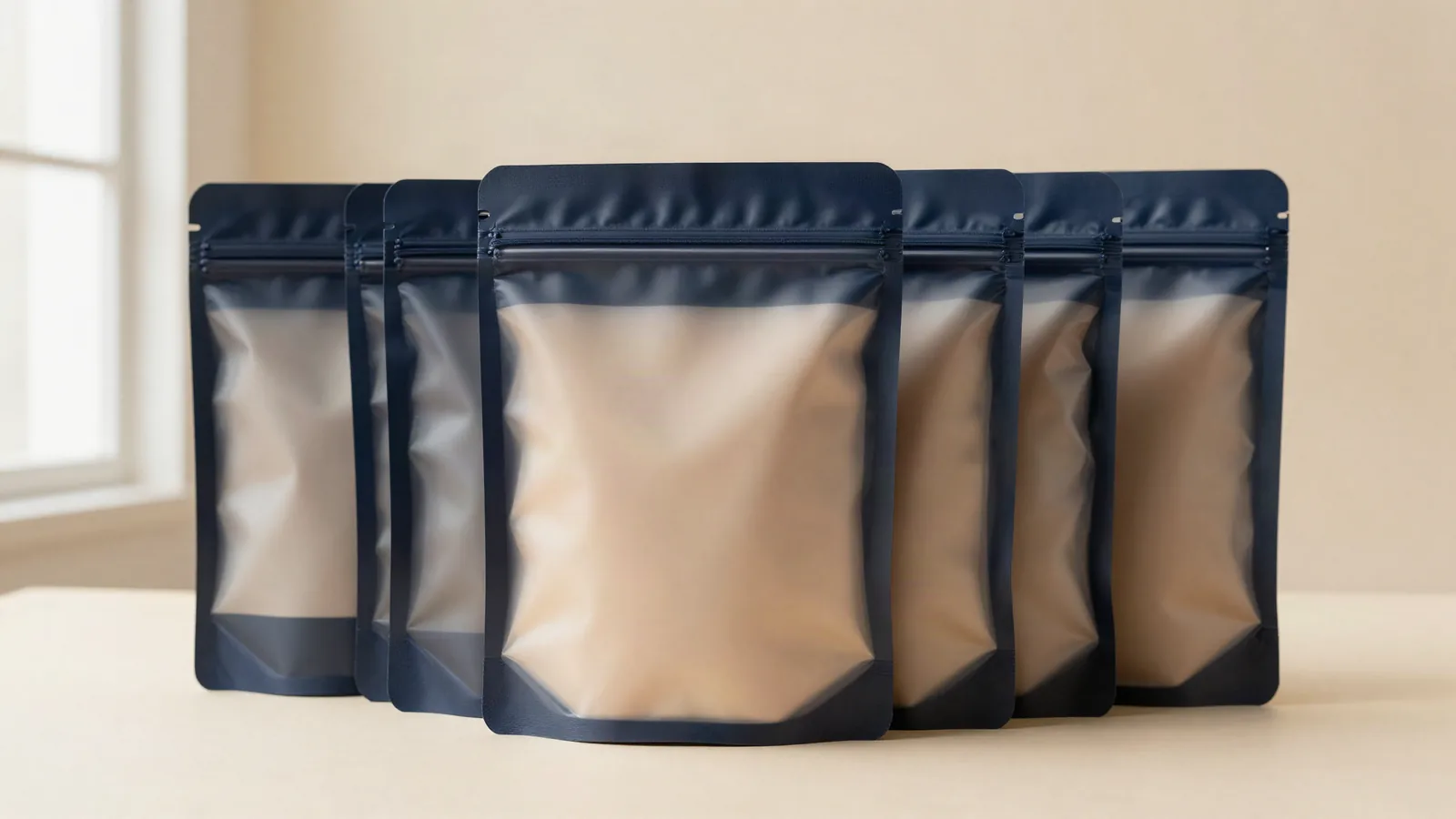




















































Why choose digital printing for stand up pouches?
Digital printing is a practical choice when a pouch program has multiple artwork versions, variable graphics, or a short run that does not justify conventional plate setup. The filled product sets the brief: record fill weight, bulk density, pouch width, height, bottom gusset, closure, tear notch, and hang hole before the dieline is drawn. A filled pouch stands differently from an empty pouch, and the front panel can change when contents settle.
Keep each SKU tied to its approved artwork file. Record the shared film, closure, and structure details separately from the design variations. That split makes a multi-SKU check easier and exposes a common late-stage problem, a pouch family that looks consistent on screen but has different seal or barrier requirements in use.
What pouch size and format should you compare?
Width is only one part of the format. Stand up pouches commonly run about 3 to 7.5 inches wide, but height, bottom gusset, seal zones, closure, and filled product determine the usable front panel. The pouch should be checked after filling, especially when irregular pieces, powders, or settled contents change the silhouette.
| Format decision | Typical industry reference | Buyer check |
|---|---|---|
| Width | About 3 to 7.5 inches | Filled width, seal allowance, and front-panel area |
| Laminate | PET / AL / PE layers | Barrier, stiffness, sealing, and product-contact question |
| Closure | Zipper, heat seal, tear notch, or a combination | Reseal, opening force, and initial seal |
| Print method | Digital print for short or variable programs | Color, fine type, and white ink |
| Finish | Matte, gloss, soft-touch, spot UV, or foil effects | Contrast, hand feel, and finish registration |
How do laminate layers change a digitally printed pouch?
Flexible packaging uses layers because one film rarely supplies print support, barrier, and sealing by itself. PET commonly supports print and dimensional stability. AL provides a strong light and barrier layer. PE is commonly used for sealing. A zipper can make a pouch easier to reseal, but it does not replace an initial heat seal when the pack needs a sealed first opening. Ask about food-contact options before selecting a package that may touch food.
Barrier needs follow the product. Moisture-sensitive powders, dry tea, botanical products, snacks, liquids, and oily contents do not place the same demand on a film system. Note sensitivity to moisture, oxygen, light, aroma transfer, and handling in the brief. A clear window can also reduce light protection, so the window decision has to be checked against the barrier job.
What artwork details matter on a pouch?
Build the artwork against the dieline, and keep important type, ingredient or nutrition information, barcodes, and variable data clear of seals, gussets, tear notches, and curved corners. Low-resolution art stays soft. RGB art can shift when converted for press. A barcode placed across a seal may distort after filling. Put a bleed on the file and keep the safe area inside the trim and seal margins.
Matte or gloss lamination changes the surface. Soft-touch changes the hand feel. Spot UV and foil stamping can separate a logo or panel detail from the rest of the artwork. White ink needs a specific check when the pouch uses transparent or metallic film. A clear PET window is commonly around 0.2 to 0.3 mm, but the suitable film depends on patch size, folding, product handling, and the need for light protection.
What should go in a stand up pouch quote request?
- State the filled product, target weight or volume, density, and whether contents settle.
- Give width and height, then note the gusset, seal area, closure, tear notch, and hang hole.
- Describe moisture, oxygen, light, aroma, opacity, and food-contact questions.
- List each artwork version and the finish areas that need separate review.
Compare zipper pouches, kraft stand up pouches, and custom stand up pouches when deciding between closure, surface, and format. The custom packaging solutions hub is useful when the pouch is part of a larger program. Order the sample kit to inspect the construction and finish before the artwork is locked.
What happens after the pouch proof is approved?
Keep the approved proof with the variation list, especially when several SKUs share one dieline. Check the filled dimensions, laminate, closure, artwork, finish, white ink, seal margins, and window boundary against that proof. We quote stand up pouches to spec from a 100-unit minimum, with pricing from $0.49 per unit at volume. Production is typically 8 to 10 business days after proof approval, plus delivery. Free US shipping and free design support are included. The sample kit costs $19.99 and can be credited to the first order.
Frequently Asked Questions
Is digital printing suitable for a small stand up pouch program?
Digital printing is commonly considered for a stand up pouch program with shorter runs, multiple artwork versions, or graphics that may change between releases. The final process still depends on film structure, ink coverage, color expectations, finishing, and quantity. Request a proof on the selected pouch material and inspect fine type, gradients, white ink, seals, gussets, and the filled front panel.
What laminate structure is common for stand up pouches?
PET, AL, and PE are common reference layers in stand up pouch laminates. PET can support print and dimensional stability, AL can provide a strong light and barrier layer, and PE is commonly used for sealing. The correct structure depends on the product and its sensitivities. Ask about food-contact options if the stand up pouch may touch food.
How wide are stand up pouches commonly made?
Stand up pouches commonly fall in a width range of about 3 to 7.5 inches. The usable format also depends on height, bottom gusset, seal area, closure, and the filled product. Empty pouch dimensions are not enough for a fit decision. Review bulk, settling behavior, and front-panel visibility with the actual contents.
What should stay away from a stand up pouch seal?
Important text, barcodes, logos, and variable information should stay clear of heat-seal areas, gussets, tear notches, and curved corners. The dieline should show the safe area, seal margin, bleed, and finish boundary. The proof also needs a check of registration and white ink, because a pouch can lose legibility after filling when copy crosses a seal or fold.
Can a stand up pouch include a clear window?
A stand up pouch can include a clear window when the film system and product goals allow it. PET window material is commonly discussed around 0.2 to 0.3 mm, although the suitable film depends on the opening, folding behavior, and handling needs. A window can reduce light protection, so check the opening, patch boundary, seal margins, and artwork clearance against the product's barrier needs.












