













































































What material should carry a custom shipment?
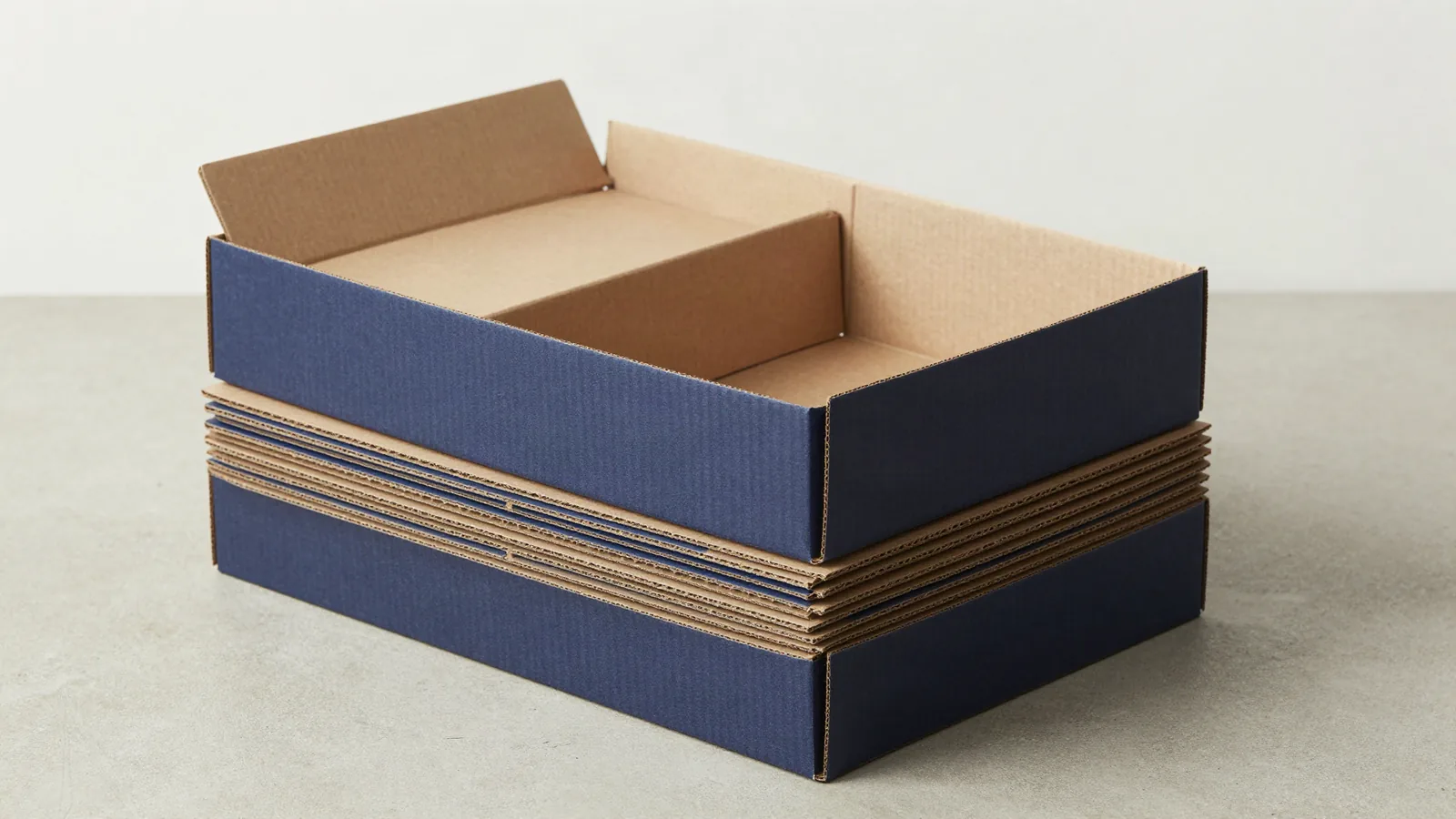
Corrugated usually carries the outer parcel, while folding paperboard and rigid construction handle different inner-package jobs. Corrugated board is a fluted paper layer between liners, so the flute changes thickness, cushioning, stacking behavior, and print surface. Edge-crush test, or ECT, is a board strength reference; 32 ECT is a common reference in shipping discussions.
| Shipping situation | Common industry reference | Design check |
|---|---|---|
| Compact parcel shipper | E flute or B flute corrugated; 32 ECT is a common reference | Check cavity, closure, and packed-product movement |
| Roomier outer carton | C flute corrugated for a different profile | Check outside size and carrier dimensional weight |
| Printed inner carton | SBS, C1S, or C2S paperboard in the 12 to 24 pt range | Check folds, print coverage, and product access |
| Presentation layer | Rigid chipboard in the 1.5 to 3 mm range, wrapped in 100 to 157 gsm art paper | Check tray, sleeve, drawer, or flap relationship |
Corrugated suits the parcel layer because the fluted middle adds structure without making the whole pack rigid. Folding paperboard keeps the printed inner carton flat before assembly. Rigid chipboard holds shape, but its wrapped corners, tray, sleeve, drawer, or flap have to be planned as one construction.
How do carrier dimensions change the material choice?
Carrier dimensional weight uses the package's outside size, while the product cavity starts with inside measurements. Write the box as length x width x depth, then label each value as inside or outside. For US ground planning, dimensional weight commonly uses L x W x H / 139. That formula is a planning convention, not a shipping quote, but it exposes the cost of extra air around a product.
Inside dimensions include the packed product, insert, closure clearance, and protective space. Outside dimensions include the board thickness, flaps, and closed structure. A roomier material can solve a fit problem and still create a larger parcel, so compare the loaded box rather than an empty dieline.
Which closure suits the packing sequence?
The packer's hand sequence should decide the closure, because the same material behaves differently at a tuck end than at a locking base. A closure is the part that keeps the package shut after loading, and its folds need room on the dieline.
A straight tuck end or reverse tuck end can suit a folding carton with a defined top opening. An auto-lock bottom or crash-lock construction changes how the base is assembled. A mailer commonly uses a roll end tuck top, with FEFCO 0427 as a common reference. Draw the open and closed states, then mark glue areas, scores, label zones, barcode zones, and any tear strip.
When should an inner box sit inside an outer shipper?
Use two cartons when the retail presentation and parcel protection need different structures. An inner printed carton can organize the product and carry its finish, while a separate corrugated shipper handles the parcel route and the outside dimensions.
Keep the inner box focused on access and product presentation. Keep the outer shipper focused on closure, size, and movement. A single carton can serve both roles when the product, dimensions, and handling path allow it; the physical sample should show whether that compromise loads cleanly.
How should custom shipping materials be printed?
Flexo is commonly used for corrugated graphics, while offset CMYK is a common reference for detailed folding-carton artwork. Digital printing can suit short runs or an artwork iteration. Matte or gloss lamination changes the printed surface, and soft-touch, spot UV, foil stamping, embossing, and debossing are separate finish decisions.
Specialty finishes usually make more sense on an inner presentation layer than on an exposed shipper. Mark print coverage and finish boundaries clearly before proof approval, then keep scores, glue flaps, labels, and barcodes legible on the assembled pack.
Which catalog formats help compare shipping materials?
The catalog gives you four format references for a material brief. Use custom shipping boxes for an outer-carton starting point and compare custom folding shipping boxes when a printed folding structure is part of the route. custom candle shipping boxes can frame a product-specific shipping conversation, while custom woozy bottle boxes show how a shaped product can drive cavity and closure planning. Treat each as a format reference, not a substitute for packed dimensions.
What should a shipping-material brief include?
A useful material brief records what enters the box, how it closes, and which dimensions the carrier will see.
- List the product, accessories, orientation, and any component that must stay separated.
- Give inside and outside dimensions, then identify the measurement convention used.
- Describe the opening, closure, insert, sleeve, tray, or outer shipper relationship.
- State artwork coverage, print method preference, and any finish layers.
- Include the delivery destination and whether carrier dimensional weight is part of the decision.
How are custom shipping materials quoted?
The quote follows the selected material, structure, print layer, and packed dimensions. Custom Packaging Lane quotes from a 100-unit minimum. Pricing is from $0.49 per unit at volume, quoted to spec. Production is typically 8 to 10 business days after proof approval, plus delivery. Free US shipping, free design support, and a free dieline are available. The $19.99 sample kit is credited to the first order. For a broader buying path, review our custom packaging solutions.
Frequently Asked Questions
How do I choose between corrugated and folding carton material?
Use corrugated when the package needs an outer shipping structure, a shipper closure, or a board reference such as E, B, or C flute. Use folding-carton paperboard when printed panels and product presentation lead the brief. Some shipments use both, with an inner carton and a separate outer shipper.
What does 32 ECT mean for a shipping box?
32 ECT is a common corrugated board reference tied to edge-crush testing. It describes one board property, not every part of a shipment's performance. Also review the flute, box dimensions, closure, packed product, stacking situation, and carrier route when comparing shipping materials.
Should carrier dimensions be inside or outside measurements?
Carrier calculations use the package's outside size, while the product cavity starts with inside measurements. Record both and label them clearly. Inside dimensions include the product, insert, and clearance. Outside dimensions include board thickness, flaps, and the closed structure used for transport.
What does FEFCO 0427 describe?
FEFCO 0427 is a common reference for a roll end tuck top mailer. A tuck end gives a familiar top closure, while auto-lock and crash-lock bases change assembly. Compare the loading direction and the number of folding or locking actions, then draw the open and closed states before the dieline is approved.
Can custom shipping packaging use printed finishes?
Custom shipping packaging can use print and finishes when placement follows the material and handling path. Flexo is a common corrugated print reference, while offset CMYK suits detailed folding-carton artwork and digital printing can suit short runs. Matte or gloss lamination, soft-touch, spot UV, foil stamping, embossing, and debossing can be considered by layer.