




























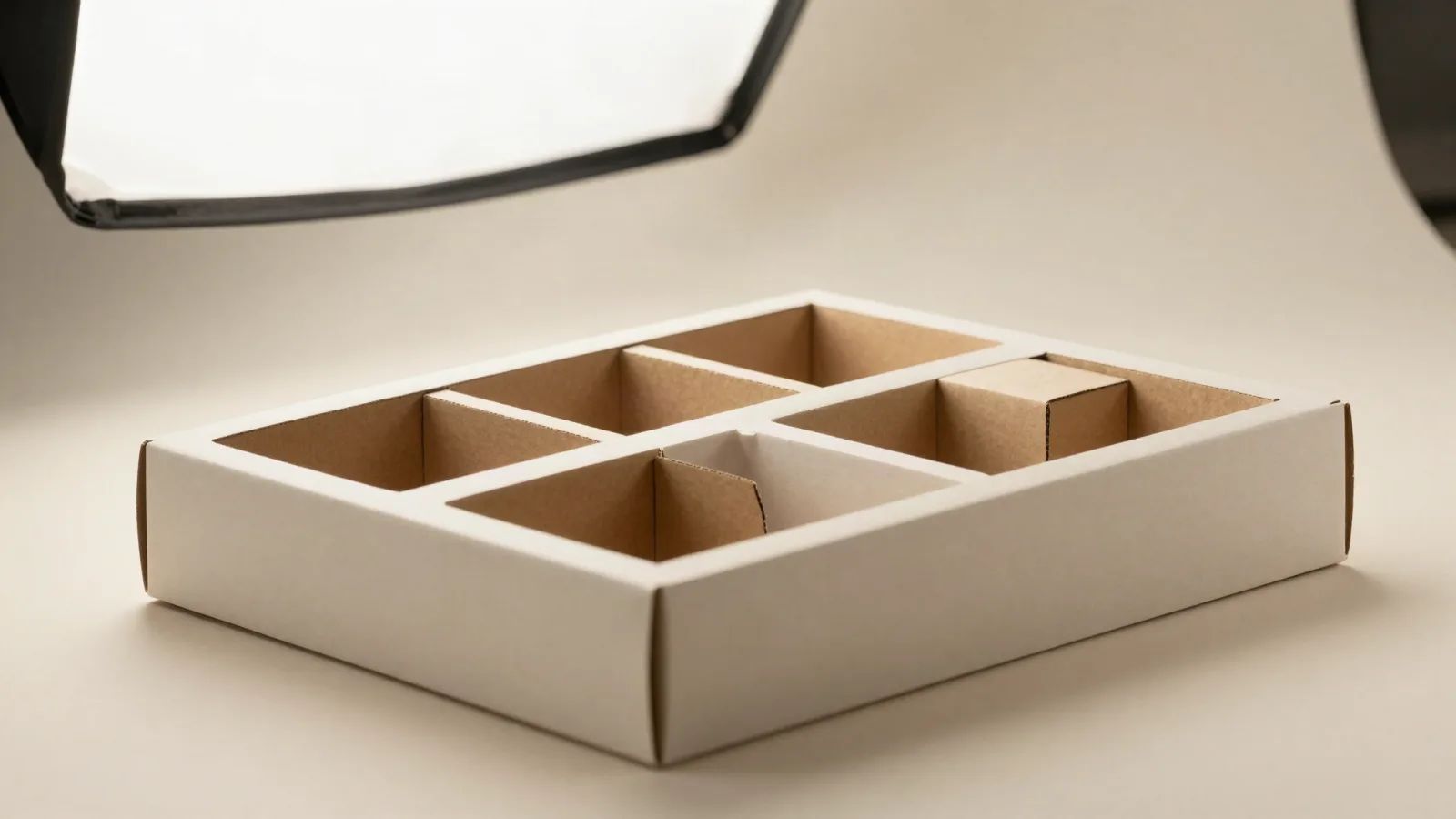




















































Foam packaging inserts are interior pieces that place a product or set in a defined position inside a box. A die-cut cavity is an opening cut to the product shape, while the surrounding foam controls contact and presentation. For retail, gift, and private-label packaging, plan the insert with the outer box, artwork, and opening sequence from the start.
How do foam inserts for packaging shape a retail opening?
Foam inserts shape a retail opening by controlling what the customer sees first and where each product sits. Decide which face appears on opening, which accessories stay beside the main item, and whether the product lifts out or comes free through a finger notch.
| Presentation goal | Interior direction | Buyer check |
|---|---|---|
| Single-product reveal | One shaped cavity with a planned product face | Does the item sit in the intended position? |
| Multi-part set | Separate cavities or organized sections | Are the components grouped in opening order? |
| Accessory display | Dedicated spaces around the main product | Can each accessory be identified? |
| Lift-out presentation | Finger access, notch, pull tab, or lift area | Can the product come out without disturbing the set? |
A presentation layout can be centered, divided, or layered. The choice follows the product and the selected box. Do not size the cavity around only the largest component when the customer is buying a set.
Which foam materials are used for packaging inserts?
Custom Packaging Lane lists PU foam, EPE foam, and EVA foam as insert directions. PU foam is often selected for a soft surface feel, EPE foam is a closed-cell polyethylene foam used for organized cushioning, and EVA foam is a denser closed-cell material used where a firmer feel and clean cavity edges matter. Confirm the proposed material against the product surface and contact points.
Material is only half the fit. Record the product outline, cavity depth, access feature, and visible areas with the material choice. If the product or an accessory may touch food, ask us about food-contact options.
What box thickness should be recorded with a foam insert?
Record the outer box construction separately from the insert material. CPL's listed card stock options are 14pt, 16pt, 18pt, 20pt, and 24pt. Listed corrugated directions are F-flute, E-flute, C-flute, B-flute, and A-flute. Listed rigid board options are 800GSM, 1000GSM, and 1200GSM.
| Package part | Listed options | What the field controls |
|---|---|---|
| Card stock | 14pt, 16pt, 18pt, 20pt, 24pt | Printed outer surface and folding structure |
| Corrugated board | F-flute, E-flute, C-flute, B-flute, A-flute | Outer box construction around the insert |
| Rigid board | 800GSM, 1000GSM, 1200GSM | Board direction for a more substantial box |
| Foam insert | PU, EPE, EVA | Product position, contact, and hand feel |
As an industry rule, E-flute is thinner than B-flute and usually prints finer detail, while B-flute gives a thicker corrugated profile. The selected box structure still has to match the product and handling route.
How should a foam insert fit a branded box?
Map the insert to the box panels and opening sequence. Decide whether the logo sits on the lid, tray, interior wall, or product-facing surface, then check whether the cavity hides the printed message.
Match each finish to the surface where it appears. Matte and gloss lamination cover the printed surface. Soft-touch adds a low-slip feel. Foil and embossing change the visible artwork, while spot UV adds a localized glossy area. Type should stay clear of scores, and the artwork needs bleed beyond the cut line.
Which CPL products fit retail and gift-set packaging?
Use custom foam box inserts for the direct insert option. wine box packaging can suit a defined bottle position. wax packaging and private label packaging cover other retail or gift-set directions. These links are category references, not a promise that every package includes foam.
What should you inspect before approving a sample?
Inspect the cavity shape, product visibility, accessory placement, lift-out access, insert edge, box opening, artwork, and finish together. Use the actual product or a representative component. The $19.99 sample kit can help you compare material and structure before approval.
For coordinated box and insert planning, use custom packaging design. The MOQ is 100 units, pricing is from $0.49 per unit at volume, quoted to spec, and production is typically 8 to 10 business days after proof approval, plus delivery. Free US shipping and free design support are available.
Frequently Asked Questions
What are foam packaging inserts used for in retail boxes?
Foam packaging inserts organize a product or set inside a retail box by giving each item a planned cavity or section. A layout can hold one product, separate accessories, or create a lift-out area. The buyer should provide product orientation, component count, visibility goals, and the outer box direction before the insert is approved.
Does Custom Packaging Lane list PU, EPE, and EVA for these inserts?
Custom Packaging Lane lists PU foam, EPE foam, and EVA foam for packaging inserts. PU is often chosen for a softer surface feel, EPE is a closed-cell polyethylene foam, and EVA is a denser closed-cell material with a firmer feel. Confirm the proposed material against product contact and cavity design.
What box thickness options can be paired with a foam insert?
Listed box options include card stock at 14pt, 16pt, 18pt, 20pt, and 24pt, corrugated F-flute through A-flute, and rigid board at 800GSM, 1000GSM, and 1200GSM. The selected outer construction should be recorded separately from the PU, EPE, or EVA insert and checked for fit.
Can a custom foam insert hold a product set?
A custom foam insert can hold a product set with separate cavities or organized sections for the main item and accessories. Provide the complete set, opening order, product faces, and removal needs. The insert and box should be checked together so the arrangement remains clear and the lid closes correctly.
What are the order terms for foam packaging inserts?
Custom foam packaging insert projects use a 100-unit MOQ. Pricing is from $0.49 per unit at volume, quoted to spec. Production is typically 8 to 10 business days after proof approval, plus delivery. Free US shipping, free design support, and a $19.99 sample kit are available.












