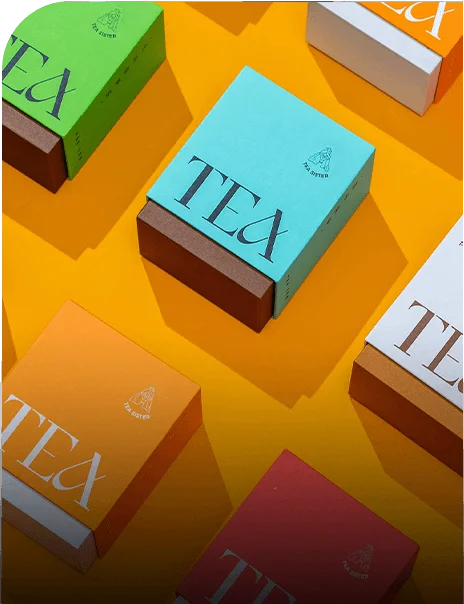




























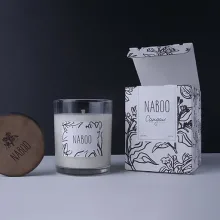
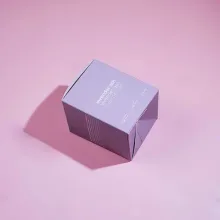
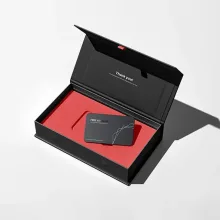
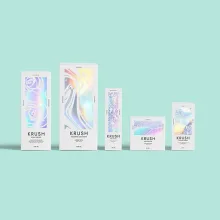
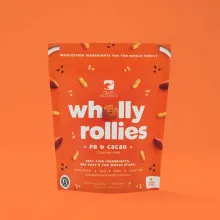
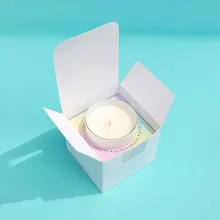





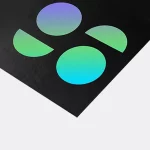
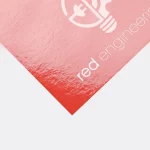






























A hologram box is a carton or other package with a light-shifting film, foil, or laminate on part or all of its surface. The structure still has to fold, close, and survive packing. A dieline is the flat cutting, scoring, and glue map used to place those decisions before print. Send the product's closed dimensions and the effect you want, not only the phrase hologram box.
What makes a hologram box shift color?
A reflective film or foil creates the color change, while CMYK ink supplies the ordinary artwork around it. Full-panel film gives the strongest visual response as the carton moves under light. A selected foil area puts that response on a logo, border, or pattern. White underprint changes color over a metallic surface, so it belongs in the artwork plan.
Which board and structure fit the product?
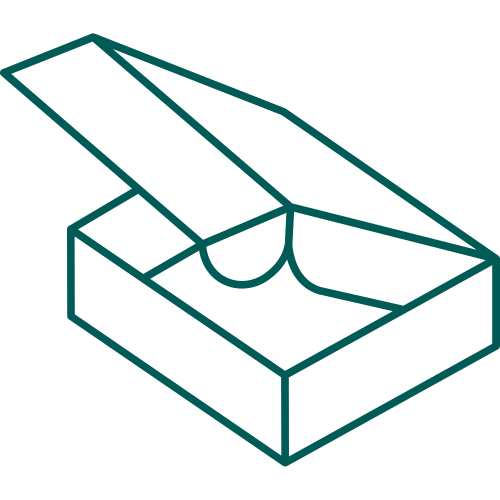
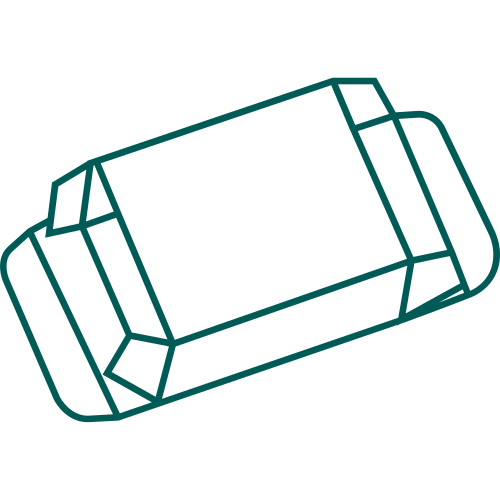
Inside length x width x depth comes before board choice, because the crease pattern and closure have to fit the packed product. Record inside measurements, then check the intended fit with about a 1/16 in, or 1.5 mm, tolerance reference. A straight tuck end, reverse tuck end, auto-lock bottom, or crash-lock base changes the way the carton loads and closes. A roll end tuck top mailer or FEFCO 0427 style adds a parcel-oriented option when the package must travel outside a retail shelf.
| Material or structure | Common trade range | Where it can fit |
|---|---|---|
| SBS, C1S, or C2S paperboard | 12 to 24 pt | Printed folding cartons with tuck or locking panels |
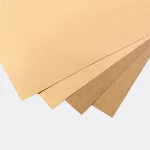
| Kraft board | 18 to 24 pt | Natural-looking cartons where board character matters |
| Rigid chipboard with art-paper wrap | 1.5 to 3 mm chipboard, wrapped in 100 to 157 gsm art paper | Presentation boxes with a firm shell |
| Corrugated outer packaging | E, B, or C flute, with 32 ECT as a common reference | Shipping support around an inner presentation box |
How do foil, film, and finishes behave on the box?
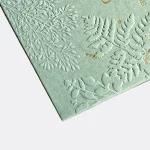
Offset CMYK suits detailed folding-carton artwork, while digital printing suits a short run or several artwork versions. Matte lamination diffuses reflection. Gloss lamination keeps highlights sharper. Soft-touch lowers the surface contrast beside bright foil. Spot UV, foil stamping, embossing, and debossing each create a separate treatment, so mark them as separate layers. Window patching can show the product, but the cutout changes panel space and reduces the area available for the light-shifting treatment.
Keep dense holographic patterns away from scores, tuck edges, and tight corners unless the converter confirms the fold. Small logos need registration between the printed artwork and the optical effect. Ask for the effect on a digital proof, and use a physical sample when the surface response is hard to judge on screen.
What drives hologram box price?
Material yield, decoration coverage, and finishing steps move a hologram box quote more than the name of the effect alone. Board caliper changes stiffness, fold behavior, material use, and packed weight. Full-panel CMYK and film coverage use more material than a small accent. Foil, spot UV, lamination, embossing, and debossing add setup and process steps.
| Price driver | Why it matters |
|---|---|
| Board caliper | Heavier stock changes stiffness, fold behavior, material use, and shipping weight. |
| Print coverage | Full-panel CMYK and metallic coverage use more ink or film than a small accent. |
| Finishing | Foil, spot UV, lamination, embossing, and debossing add process steps and setup. |
| Quantity breaks | Fixed setup work is spread across the run, so quantity changes the unit calculation. |
| Tooling | Custom dies or plates may be needed for structural cuts or raised decoration. |
| Shipping zone | US ground dimensional weight commonly uses L x W x H divided by 139. |
Which packaging formats help compare the structure?
A wine box packaging reference puts attention on a tall footprint and a structured presentation. A shoe box packaging reference is useful for a broad top panel. An embossed tin box gives a different way to study metallic decoration and tactile detail. Custom foam box inserts show how interior support changes the usable space inside a box.
What belongs in a hologram box quote?
A usable quote request names the product dimensions, opening, inside measurements, hologram coverage, board or base material, and delivery ZIP code in the first message. State whether the effect covers the exterior or selected panels. If an insert is involved, include the insert material and the space it occupies. The dieline can then account for folds, seams, glue zones, registration, and packed orientation.
Custom Packaging Lane quotes hologram boxes to spec from a 100-unit minimum, with pricing from $0.49 per unit at volume, quoted to spec. Production is typically 8 to 10 business days after proof approval, plus delivery. Free US shipping, free design support, and a free dieline are included. The $19.99 sample kit is credited to the first order. Start with custom packaging design and send the effect map with the product dimensions.
Frequently Asked Questions
Does CMYK create a hologram box effect?
CMYK ink supplies ordinary color and imagery, but CMYK alone does not create the light-shifting response on a hologram box. A film, foil, laminate, or selected optical layer creates that response. White underprint changes the color over a metallic surface, so the artwork should show the print layer and effect layer separately before approval.
Can a holographic finish cross a fold?
A holographic finish can cross a fold only after the construction is checked against the film or foil. Scores and tight corners can interrupt a pattern, crack a surface, or shift registration. Keep the strongest pattern away from tuck edges and creases when possible, and show the score, trim, glue area, and effect boundary on the dieline.
Is 12 to 24 pt board right for every hologram box?
No single board range fits every hologram box. SBS, C1S, or C2S paperboard in the 12 to 24 pt range suits many folding-carton discussions, while a larger panel, heavier product, rigid shell, or insert can change the choice. Check the board against the product load, crease pattern, closure, and packed orientation rather than choosing caliper from artwork alone.
What should a hologram box proof show?
A hologram box proof should show the flat panel order, trim, scores, glue zones, effect boundary, pattern direction, print layers, and finish areas. It should also show where a window, insert, barcode, or small logo sits. Compare the flat file with a folded mockup when the pattern meets a crease, tuck edge, or seam.
Why can two hologram boxes look different under light?
Two hologram boxes can read differently because board color, surface texture, laminate, coverage, viewing angle, and ambient light change the reflection. Matte lamination spreads highlights, gloss keeps them sharper, and kraft gives a different base than white paperboard. Ask to see the effect on the intended material, especially when a small logo or repeated pattern carries the design.