




























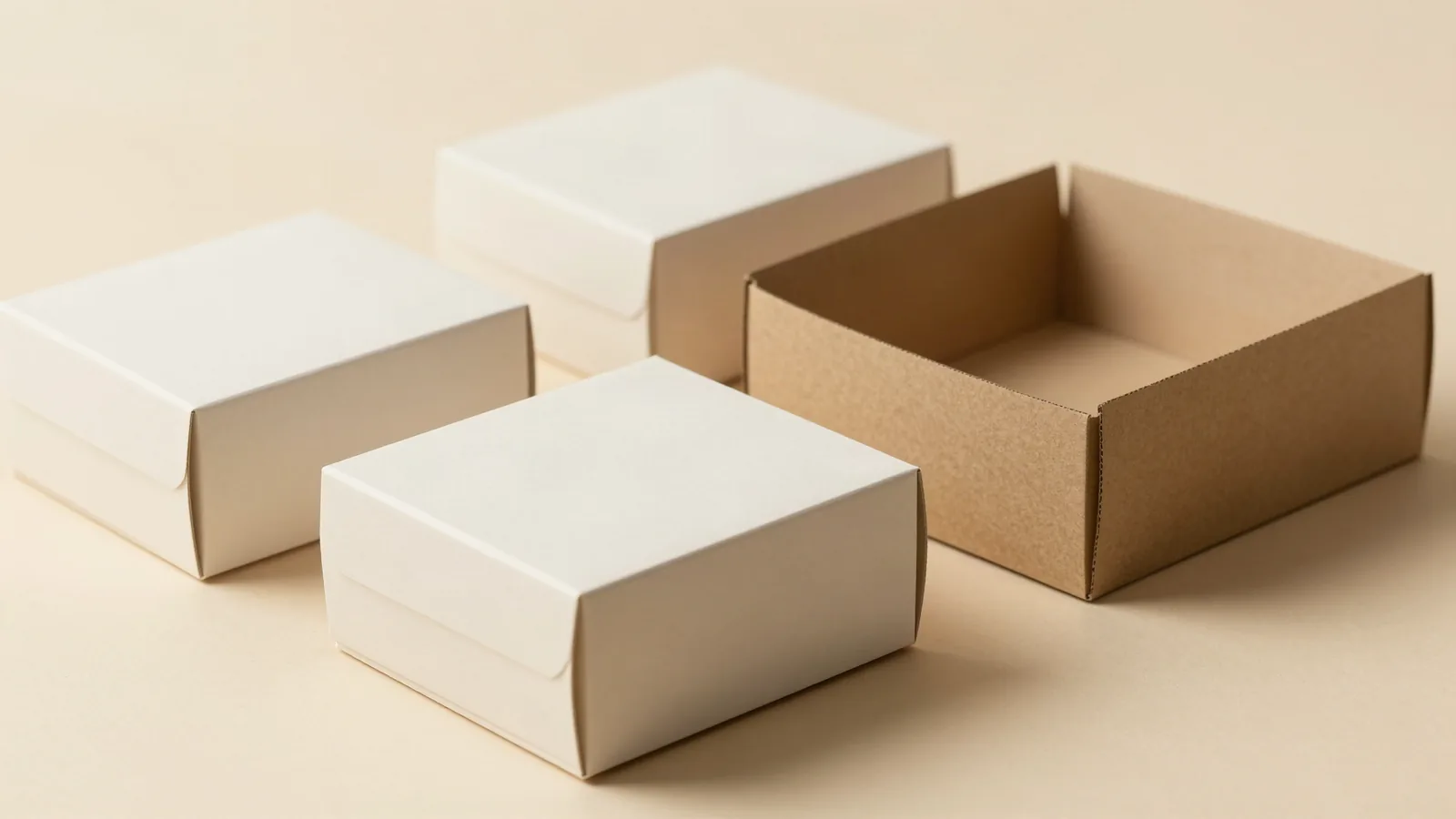




















































Personalized corrugated boxes are printed corrugated boxes whose outside panels carry a brand, product message, or handling copy. The construction decision comes before the decoration: a box that looks right on a screen still has to close, stack, move through packing, and arrive without the front panel landing across a score. Compare window display boxes, window boxes, and waffle boxes when the package needs a visible product or a different opening shape.
What does personalization change on a corrugated box?
The first practical change is the panel plan, because a closed carton presents only some faces at once. A dieline is the flat cutting template that shows panels, scores, cuts, glue tabs, and closure flaps before the board is cut. Mark the front, top, sides, back, and bottom on that template. Keep the logo and opening instruction away from scores and glue zones. A score can break small type, and a glue tab can disappear inside the finished seam.
Set the reading order while the box is closed, then check it again with the lid open. Reserve a quiet panel for directions or a product identifier. If an insert changes the opening sequence, draw the insert into the same review instead of sizing the carton around an empty cavity. A product that rattles in an insert cut to the exact product shape needs a packaging change before artwork approval.
Which flute should go into a personalized corrugated box?
E-flute gives a lower corrugated profile for fine print, while B-flute and C-flute leave more board depth for a shipping-oriented build. Flute is the shaped middle layer inside corrugated board. It changes the board thickness, fold feel, print surface, and room available around the product. 32 ECT means edge crush test, a common board-strength reference, not a universal instruction for every carton.
| Construction reference | Physical difference | When it fits the brief |
|---|---|---|
| E-flute | Lower profile corrugated board | Fine print and compact folds |
| B-flute | Moderate board depth | More room around the product |
| C-flute | More pronounced board profile | Shipping formats with added interior space |
| 32 ECT | Edge crush test reference | A shared board reference in the quote |
What paperboard and finish choices fit the print?
SBS, C1S, and C2S paperboard are smooth stock references in the 12 to 24 pt range, while kraft board commonly falls in the 18 to 24 pt range. Caliper is the thickness of the board. It affects fold behavior, edge feel, and the space left inside the finished carton. Offset CMYK suits detailed coverage on a paperboard layer, digital printing suits shorter runs or artwork tests, and flexo is common on corrugated board.
Matte lamination cuts glare, while gloss lamination increases reflection. Soft-touch changes the hand feel. Spot UV puts a hard, glossy highlight on a selected logo or detail. Foil stamping, embossing, and debossing need clear space in the artwork plan, and essential copy should stay away from folds, seams, glue areas, and reflective effects.
Where should dimensions appear on the dieline?
Inside dimensions are the starting measurement because they describe the product cavity. Write the box as length x width x depth and label every value as inside or outside. A common planning tolerance is about 1/16 in, or 1.5 mm, but the finished fit still needs a check against the actual board, insert, and product. PET window material commonly falls in the 0.2 to 0.3 mm range, and its patching area belongs on the construction drawing.
For US ground planning, dimensional weight is commonly discussed as L x W x H / 139 using the outside packed dimensions. That is a carrier calculation convention. Check the packed master carton as well as the individual box, because nested, flat, and assembled states occupy different space.
Which artwork faults should be caught before the press run?
Common avoidable faults include low-resolution art, RGB files that shift after conversion for press, type set too close to a score, and bleed left off the file. A digital proof is the flat-art check before anything prints. It should show panel orientation, score positions, bleed, barcode location, and heavy ink coverage. At a press check, look at color conversion, registration, small type, and whether a heavy area or finish crosses a score.
A physical sample answers fit and handling questions that artwork alone cannot. Load the actual product and insert, close the box, pick it up, open it, and inspect the face panel. Use the sample kit to compare board feel, folds, closure action, and finish before the structure is approved.
To request a quote, send product dimensions, inside or outside box dimensions, intended flute, panel artwork, finish, closure, and any window or insert requirements. Custom Packaging Lane quotes from a 100-unit minimum, with pricing from $0.49 per unit at volume, quoted to spec. Production is typically 8 to 10 business days after proof approval, plus delivery. Free US shipping, free design support, and a free dieline are included. The $19.99 sample kit is credited toward the first order. Start with custom packaging design so the structure and artwork arrive in the same brief.
Frequently Asked Questions
Can personalized corrugated boxes include a window?
Personalized corrugated boxes can include a PET window when product visibility belongs in the package plan. PET window material commonly falls in the 0.2 to 0.3 mm range. Place the window after product orientation and panel copy are set, then keep scores, glue areas, and small text away from the patching zone.
What does 32 ECT mean for a corrugated box?
32 ECT means edge crush test, a common corrugated board-strength reference. It gives a quote a shared comparison point for board performance. The number does not choose the carton by itself. Product dimensions, flute, packed configuration, stacking path, and the amount of interior protection still belong in the box brief.
How do E-flute, B-flute, and C-flute differ?
E-flute has a lower profile and finer print surface than B-flute or C-flute. B-flute gives more board depth, while C-flute gives a more pronounced profile for shipping formats. Compare the product footprint, fold pattern, printed detail, and protection required before fixing the flute in the dieline.
What is a dieline for personalized corrugated boxes?
A dieline is the flat cutting template for a box. It shows cut lines, scores, panels, glue tabs, closure flaps, and any window opening before production. Buyers should place the product footprint and insert on that template, then check inside dimensions, artwork orientation, bleed, and copy clearance around every score.
What should I check in personalized corrugated box artwork?
Before approving personalized corrugated box artwork, check low-resolution images, RGB-to-press color conversion, bleed, score placement, glue zones, panel order, and barcode location. A physical sample adds checks for fold behavior, closure action, product movement, and whether ink coverage or a finish competes with small copy.












