

























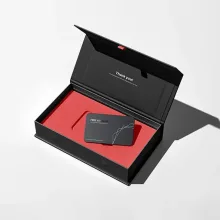










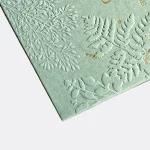

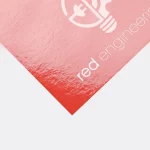






























A rigid set up box is a fixed-form package built around a firm chipboard core rather than a sheet that folds into shape at packing. The core holds the assembled walls, while a printed paper wrap carries the artwork across the outside. The lid, base, sleeve, tray, drawer, or insert then determines how the product is revealed and removed.
What is a rigid set up box made from?
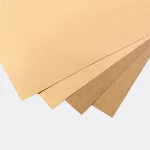
A rigid set up box is made from chipboard covered with printed paper, with the selected thickness tied to the box dimensions and construction. Chipboard is a dense board used as the structural core. The covering paper carries print and finish, while the lid, base, tray, or insert defines the usable interior. Ask for the selected board thickness in the quote or proof rather than treating one value as universal.
| Construction stage | Material or component | What to approve |
|---|---|---|
| Core | Rigid chipboard | Thickness selected for the dimensions and structure |
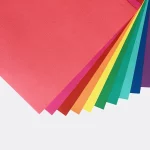
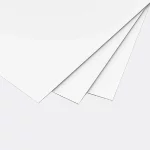
| Outer surface | Printed paper wrap | Artwork, color coverage, panel alignment, and finish |
| Opening | Lid, base, sleeve, tray, drawer, or flap | How the product is revealed and removed |
| Interior | Open cavity or specified insert | Fit, clearance, movement, and presentation |
How are rigid boxes made from chipboard to finished pack?
Rigid box construction starts with the packed product, its dimensions, and the way it should sit inside the box. The dieline, which is the flat cutting template for the package, is drawn from that information. The board shape, wrap, opening, and interior parts then need to agree before the proof is approved.
Send the packed product length, width, height, orientation, and quantity of components.
Select the chipboard direction and paper wrap for the proposed structure.
Choose the opening, such as a lid and base, sleeve and tray, drawer, flip, or other specified arrangement.
Set print coverage and finishes such as matte, gloss, soft-touch, foil, spot UV, embossing, or debossing.
Review the digital proof for fit, clearance, artwork near scores, and opening behavior before printing.
At proof stage, look at the details that cause rework. RGB artwork can shift when converted for press, low-resolution logos can show rough edges, and type set too close to a score can land on a fold. The wrap file needs bleed beyond each cut edge, and a barcode needs clear space to scan. Check those details before the production clock starts.
How does a two piece rigid box differ from a sleeve and tray?
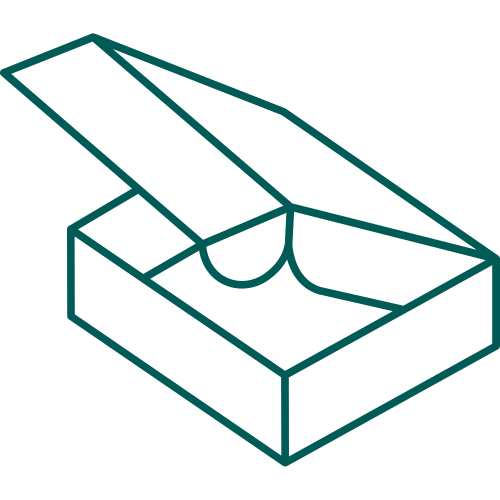
A two piece rigid box has a separate lid and base, so the lid lifts away from the lower component. A sleeve and tray adds an outer sleeve around a sliding tray, which changes the direction of access and the visible sequence. Both formats use a rigid core, but the lid clearance, tray fit, wrap coverage, and assembly plan are different.
Review custom rigid set up boxes for the core construction, rigid printed boxes for surface and decoration choices, and rigid boxes with sleeve and tray when the opening needs a sliding reveal.
What should I approve before rigid box production?
Approve the chipboard thickness, outside and inside dimensions, lid or sleeve clearance, wrap paper, print panels, finish placement, and insert requirements. Check that type does not sit on a score, that artwork includes bleed, and that the insert leaves enough clearance for packing and removal. The production clock begins after proof approval, not when the order is first discussed.
Custom orders start at 100 units. Pricing is from $0.49 per unit at volume, quoted to spec. Production is typically 8 to 10 business days after proof approval, plus delivery. Free US shipping and free design support are available.
How can I compare rigid box materials before ordering?
The $19.99 sample kit lets you compare board, wrap, print, and finish direction in hand before approving a custom proof. Use custom packaging solutions to send the dimensions, artwork, quantity, and construction you want reviewed. If the package is intended for food, ask us about food-contact options for your product.
Frequently Asked Questions
What material is used in a rigid set up box?
A rigid set up box uses a chipboard core covered with printed paper. Chipboard supplies the fixed structure, while the paper wrap carries artwork and finishes. The selected thickness depends on the box dimensions, lid or base relationship, sleeve or tray, and interior plan, so the quote or proof should name the chosen board specification.
How is a two piece rigid box constructed?
A two piece rigid box is constructed from separate lid and base components. The lid covers the base, and the clearance between them is planned around the board, wrap, product cavity, and any insert. The digital proof should show the outside dimensions, opening relationship, printed panels, finish placement, and interior parts included in the quote.
What is the minimum order for rigid set up boxes?
The minimum order for rigid set up boxes is 100 units. Pricing is from $0.49 per unit at volume, quoted to spec. Production is typically 8 to 10 business days after proof approval, plus delivery. Free US shipping and free design support are available, and the sample kit costs $19.99.
How long does rigid box production take?
Rigid box production is typically 8 to 10 business days after proof approval, plus delivery. The clock starts after the structure and artwork are approved, not when the first concept is discussed. The final timing should be planned around the selected board, wrap, opening, inserts, quantity, and destination.
Can Custom Packaging Lane help with rigid box design?
Custom Packaging Lane provides free design support for the rigid box plan. Send the product dimensions and desired opening, and the design support can organize the dieline, artwork panels, wrap, insert, and finish direction before the digital proof. Printing follows proof approval, so construction details should be checked at that stage.