




























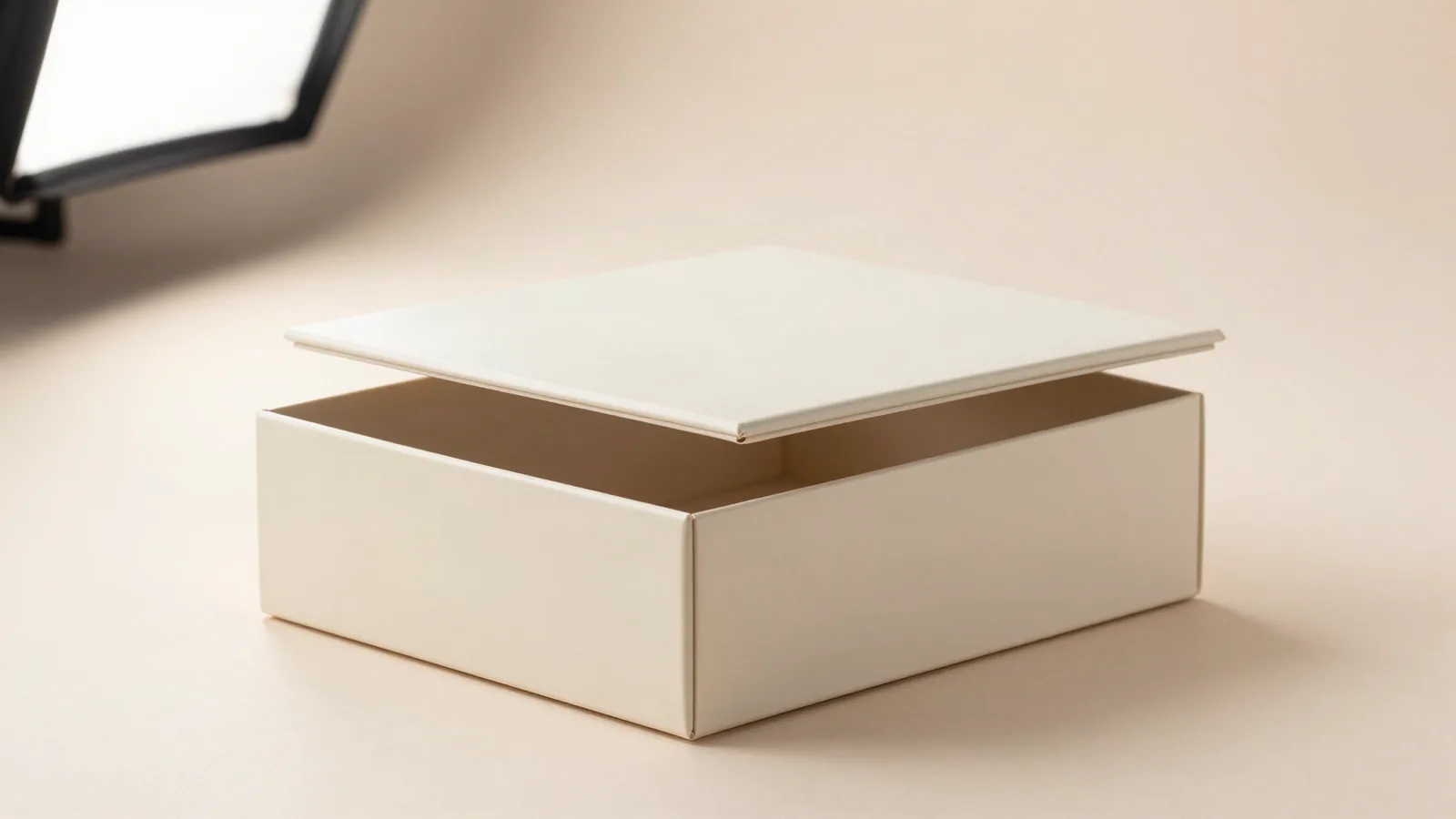




















































How does a rigid tray with lid box work?
The tray carries the product, and the lid lifts away as a separate piece. Together, the two parts create a base-and-top structure with a clear opening sequence. Common rigid construction uses 1.5 to 3 mm chipboard wrapped in 100 to 157 gsm art paper. Chipboard supplies the core; art paper supplies the printable wrap.
A useful quote starts with packed dimensions, desired clearance, tray height, lid depth, and insert details. See custom cardboard boxes with lid and tray for a related format. A tray-and-lid box can stand alone as a two-piece rigid format, or the tray can pair with an outer sleeve. State whether the lid lifts off, slides, or connects with a flap before the dieline is drawn.
Which tray and lid format should buyers compare?
A lift-off lid gives a direct reveal, while a sleeve guides the tray through a second outer piece. A fitted insert holds a product in a fixed cavity, and a magnetic rigid format uses a hinged flap with closure hardware.
| Format | How it opens | Planning focus |
|---|---|---|
| Lift-off lid and tray | Lid lifts vertically | Clearance, grip, and reveal |
| Tray with sleeve | Tray slides through sleeve | Guided movement and branding area |
| Tray with insert | Product lifts from a cavity | Product security and presentation order |
| Magnetic rigid format | Flap opens and closes | Closure feel and hardware placement |
Compare jewelry boxes with lid and tray when the product needs a fitted presentation, custom lid and tray soap boxes for a compact product layout, and rigid boxes with magnetic closure when the lid should stay attached.
How should the tray be sized around the product?
Inside length x width x depth gives the starting measurement for a fitted tray. A common packaging convention allows about 1/16 inch, or 1.5 mm, tolerance, but clearance still depends on product geometry, insert material, and removal method. A snug fit can improve presentation and still make removal hard; a loose fit lets the product move. Define the removal gesture, not just the nominal size.
For a single item, a shaped cavity or lift ribbon can make access easier. For multiple pieces, partitions or a fitted platform establish a repeatable layout. If a product has a delicate surface, specify where the insert touches it and whether that contact area needs softer material. The lid must clear both the product and the insert without compressing either one.
Tray depth and lid clearance need a joint check. A lid that looks generous from the outside can still interfere with a tall product or insert. The tray edge also needs exposed area for gripping the base without disturbing the contents. If the package opens at retail or in a gift setting, decide whether the product should be visible before the lid is fully removed.
Which print and finish details matter most?
Offset CMYK carries detailed artwork on the wrapped rigid board. Matte lamination reduces glare, gloss lamination increases reflection, and soft-touch changes the tactile response. Spot UV, foil stamping, embossing, and debossing can distinguish a logo or border, but each treatment belongs on the exact panel where it will appear. A lid, tray exterior, tray interior, and sleeve can each need different artwork treatment.
Use the opening sequence to place information. The lid can carry the first brand cue, while the tray interior can carry a message revealed after opening. Ask us about food-contact options for your product. Child-resistant construction can be built when the application calls for it, but it is a feature to scope and evaluate for the specific use.
What should I ask rigid tray with lid box manufacturers?
A useful quote request names packed dimensions, tray depth, lid style, insert needs, artwork coverage, finish, and destination. Cost drivers commonly include board caliper, print coverage, finishing, quantity breaks, tooling, and shipping zone. A sample can expose lid friction, tray alignment, surface feel, and product removal before the structure is fixed.
- Confirm whether the lid is lift-off, sleeve-based, or magnetic.
- Provide inside dimensions and insert clearances.
- Specify printed panels and special finishes.
- Test loading and opening with the finished product.
Custom Packaging Lane provides free design support and a free dieline for this planning stage. The quoting basis is a 100-unit minimum. Pricing is from $0.49 per unit at volume, quoted to spec. Production is typically 8 to 10 business days after proof approval, plus delivery. Free US shipping is available, and a $19.99 sample kit is credited to the first order. Start with custom packaging solutions.
Frequently Asked Questions
Does the lid sit inside or outside the tray?
A rigid tray-and-lid box uses the tray as the base and the lid as a separate top that fits over it. A sleeve-and-tray format uses an outer sleeve around a sliding tray instead. The correct arrangement depends on the opening motion, grip area, insert depth, and the printed panels the package needs.
What clearance does a rigid tray need?
A rigid tray needs clearance based on the product, insert, wrap thickness, and removal method. Dimensions are commonly recorded as inside length x width x depth, with about 1/16 inch, or 1.5 mm, as a planning tolerance. Test the actual product because a snug fit can still make removal difficult.
How does an insert change a tray-and-lid box?
A custom insert creates a cavity, partition, platform, or shaped support inside a tray-and-lid box. It can control movement and presentation order, but it also consumes tray depth and lid clearance. Specify contact points, removal access, and the order in which the buyer sees each item before fixing the dieline.
Can a tray-and-lid box hold food products?
A tray-and-lid box for a product that touches food needs the exact material and use reviewed during quoting. Ask us about food-contact options for your product. Keep the food-contact question separate from the box structure, insert, lid clearance, print, and finish so the package specification stays precise.
How does a magnetic lid compare with a lift-off lid?
A magnetic lid stays attached on a hinge and opens along a set path, while a lift-off lid separates from the tray for a direct reveal. Magnetic construction suits repeated access; a lift-off lid keeps the two-piece structure simple. Compare closure placement, insert retention, grip, and the way the product is removed.












