




























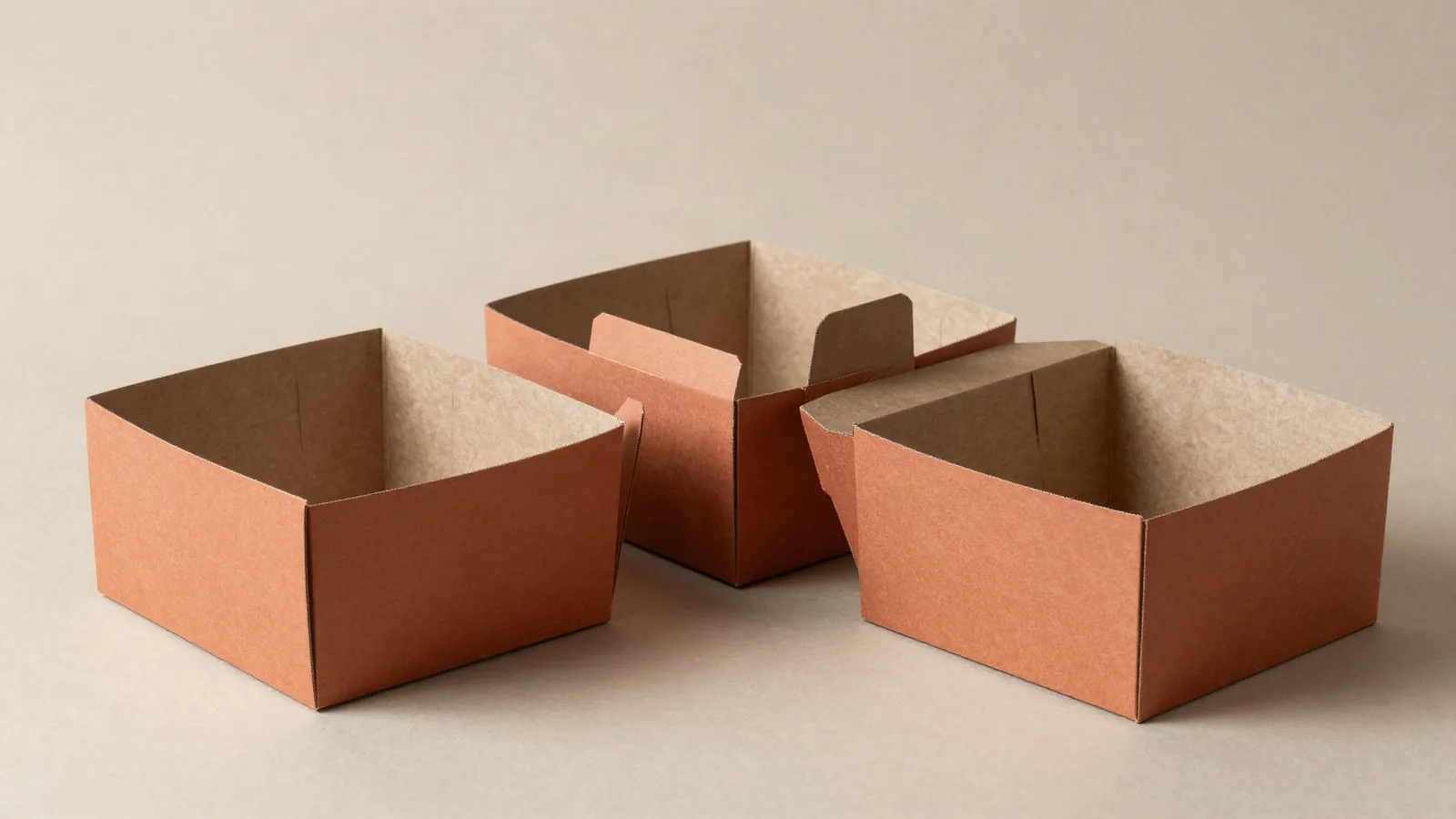




















































A roll end tuck front box, often shortened to RETF, uses rolled end panels with a front tuck closure. The name describes the folding relationship, not the finished dimensions, board, print coverage, finish, or inside support. A clean RETF request keeps those fields beside the style name so purchasing, design, and packout teams are working from one structure.
What does RETF mean on a packaging request?
RETF means roll end tuck front. The abbreviation names the rolled end panels and the front tuck closure, but it does not set the size, board, print coverage, finish, or inside support.
Write roll end tuck front box beside RETF in the request. The roll end tuck front boxes catalog page gives the team a direct construction reference before artwork starts. The assembled opening should be checked with the packed product in place, because the style name alone cannot show how much clearance the tuck needs.
How does the RETF closure behave at packout?
The front tuck closes the main access point, while the rolled ends turn the side panels into the body of the box. The base supports the packed product, and the rear panel completes the outside sequence.
| Box area | Packout job | Artwork check |
|---|---|---|
| Front tuck | Closes the main opening | Keep the front message readable after closing |
| Rolled ends | Turn side panels into the box body | Check side graphics after folding |
| Base | Supports the packed product | Keep small copy clear of the bottom folds |
| Rear panel | Completes the outside panel sequence | Confirm orientation when the box is loaded |
Mark the front, back, ends, base, fold lines, and tuck area on the dieline. The assembled proof should show the same orientation. That keeps the person packing the product and the person approving the design looking at one package instead of separate flat panels.
What size references can start an RETF brief?
CPL's published tuck chart lists inside planning sizes that can start an RETF discussion. These rows are reference points, not a promise that every product fits every row. Match the packed product to the inside dimensions, then request the structure-specific dieline.
| Inside planning size | Millimeter equivalent | Useful starting direction |
|---|---|---|
| 2 x 2 x 4 in | 51 x 51 x 102 mm | Small boxed item or upright display |
| 3 x 2 x 6 in | 76 x 51 x 152 mm | Tall retail item |
| 4 x 3 x 8 in | 102 x 76 x 203 mm | Long product with an end opening |
| 6 x 4 x 2 in | 152 x 102 x 51 mm | Flat display or shallow pack |
| 8 x 5 x 2 in | 203 x 127 x 51 mm | Multi-item shelf presentation |
Which board callout fits a roll end tuck front box?
The board callout for an RETF box should name paperboard or corrugated stock, its direction, and the selected flute when corrugated. CPL's material list names SBS cardstock from 16 to 24 pt and corrugated E, B, and AB flute directions. A point callout describes paperboard thickness. E flute gives a finer print surface and a smaller fold profile, while B flute gives more board depth for a different handling brief. AB combines flute profiles.
The same list names kraft, metallic foil, textured linen, and white stock. Those terms describe material or surface direction, not the complete construction. State the product footprint, packed orientation, print coverage, and finish request so the quoted board matches the actual RETF dieline.
Where should the artwork go on an RETF box?
Put the main product or brand message on the panel that faces the buyer when the box is closed. Keep small type away from the tuck edge, scores, joining areas, and fold transitions. Show the front face both closed and open. RGB art can shift when converted for press, and missing bleed can expose an unprinted edge.
Check the front panel at the same angle the box will be viewed. A logo that looks centered on a flat file can move visually after the end panels fold around the box. Keep a window or foil feature clear of the opening path.
How do teams keep RETF files consistent?
Use one naming line in every file: roll end tuck front box, RETF. Add the product dimensions, packed orientation, quantity, board direction, artwork status, finish, and destination. Use custom tuck end boxes and custom seal end tuck boxes as comparison points when the team needs to separate related tuck constructions. Shoe box packaging is another product-shaped reference for a package that needs clear orientation.
What are the order terms for RETF boxes?
The MOQ is 100 units. Pricing is from $0.49 per unit at volume, quoted to spec. Production is typically 8 to 10 business days after proof approval, plus delivery. The clock starts after proof approval.
Free US shipping and free design support are available. The $19.99 sample kit can help compare board and finish directions before approval, while custom packaging design support can help coordinate the artwork and dieline handoff.
Frequently Asked Questions
What should RETF stand for in a quote?
RETF means roll end tuck front. The abbreviation names the rolled end panels and the front tuck closure, but it does not set the size, board, print coverage, finish, or inside support. Write roll end tuck front box beside RETF in the request so the quote, dieline, and proof use the same structure.
Can a roll end tuck front box use paperboard or corrugated stock?
A roll end tuck front box can use paperboard or corrugated material listed for the selected build. CPL's catalog names SBS cardstock at 16 to 24 pt and corrugated E, B, and AB flute directions. The quote should identify the chosen board and flute, then the proof should confirm the assembled fit.
Which inside sizes appear in CPL's RETF planning chart?
CPL's planning chart lists inside sizes of 2 x 2 x 4, 3 x 2 x 6, 4 x 3 x 8, 6 x 4 x 2, and 8 x 5 x 2 inches. Metric equivalents appear beside them. Treat these as starting references and request the final RETF dieline against the packed product.
Should a logo cross the front tuck score?
A logo should stay readable on the closed front face, and small copy should stay clear of the tuck edge, scores, joining areas, and fold path. Check the artwork in both closed and open positions. RGB conversion, missing bleed, and low-resolution files are prepress problems to catch before proof approval.
What order terms apply to a roll end tuck front box?
A roll end tuck front order has a 100-unit MOQ. Pricing is from $0.49 per unit at volume, quoted to spec. Production is typically 8 to 10 business days after proof approval, plus delivery. Free US shipping and free design support are available.












