




























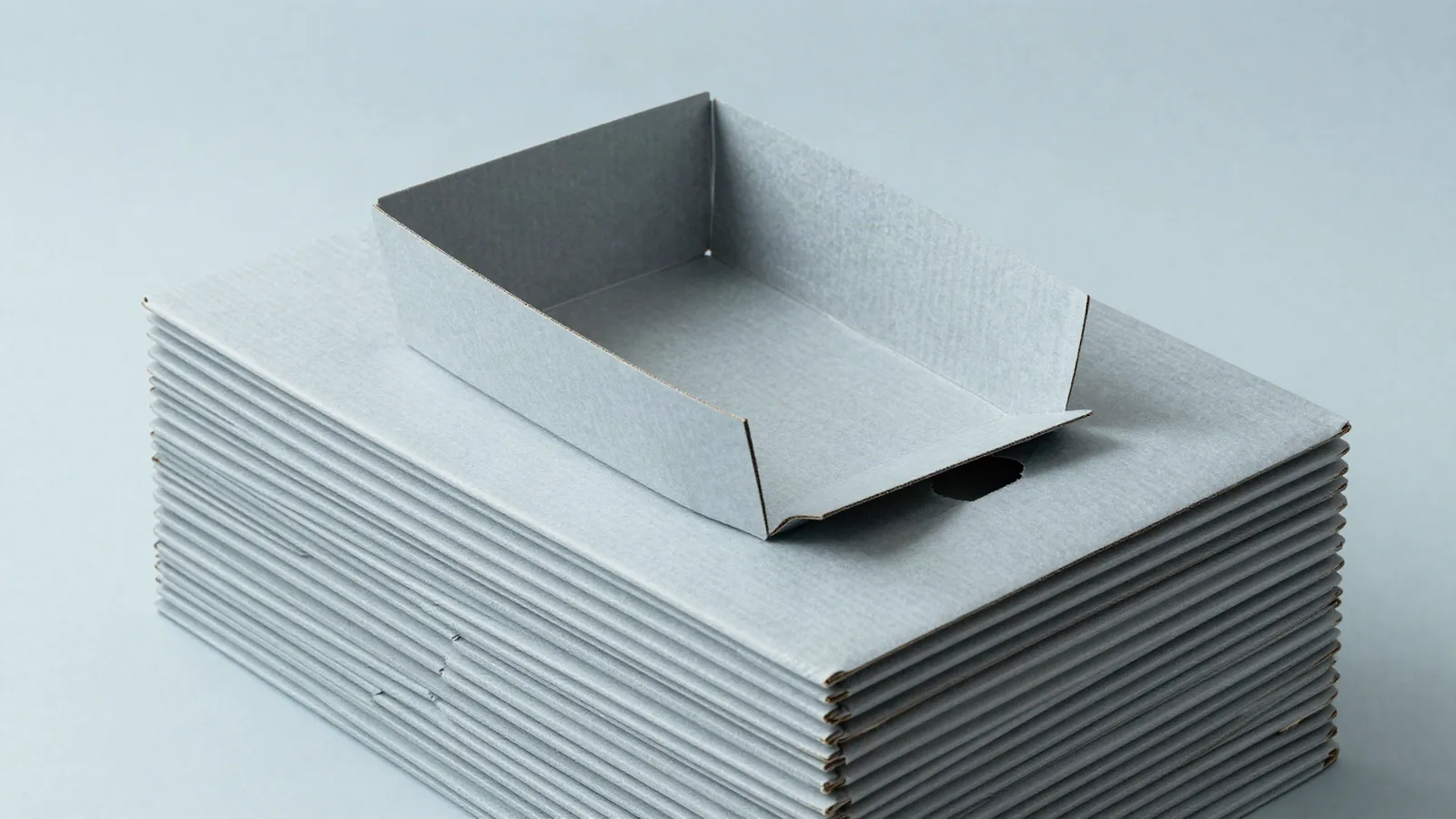




















































What are the main types of corrugated boxes?
Corrugated board is made from liner sheets bonded to a fluted paper layer. The flutes create the board's structure, while the liners provide the outer faces for printing and handling.
A corrugated box type tells you where to start the packaging brief. It does not confirm an unlisted board grade, dimension, load rating, or performance promise. The product, opening, visibility, artwork, and delivery context still need to be settled in the proof.
How can buyers compare the main corrugated box routes?
Compare corrugated box routes by the opening, product category, visibility, and handling job named by the product page. The catalog gives each route a clear starting point.
| Catalog route | Product reference | What to compare |
|---|---|---|
| General corrugated | corrugated boxes | Overall box construction and product fit |
| Mailer | custom corrugated mailer boxes | Fold-over opening and mailer handling |
| Cake category | cake corrugated boxes | Product category, fit, and visibility |
| Window display | window display boxes | Visible product area and front panel |
| Window soap | window soap boxes | Window presentation and product route |
| Window | window boxes | Opening placement and printed surround |
The table separates catalog names from final specifications. A box can share a broad corrugated label with another format while using a different opening, window position, or internal arrangement.
How do corrugated mailer boxes differ from general corrugated boxes?
Corrugated mailer boxes add a planned opening and fold-over sequence to the general corrugated box decision. A mailer usually folds from one piece and uses tuck panels or locking tabs, while a general corrugated brief starts with the box body and product fit.
Review the product dimensions, packed product, opening action, and artwork before choosing the mailer route. Type that sits too close to a score can break when the mailer folds. A missing bleed can leave a white edge at the cut. The box should be checked assembled, not only as a flat sheet.
When does a window format belong in a corrugated comparison?
A window format belongs in the comparison when the buyer wants a selected part of the product visible before opening. A window is usually a die-cut opening with a clear film patch, so its size and placement change the balance between product visibility and printed coverage.
Use window display boxes, window soap boxes, and window boxes as separate catalog routes. The window label does not specify the exact panel, product position, or dimensions. Those details belong in the dieline and proof.
How do flute and liner choices change a corrugated box?
Flute choice changes the board's thickness, print surface, folding behavior, and stacking response. E-flute is thinner and gives a smoother print face for finer detail. B-flute is thicker and provides more board structure. The correct board direction depends on the product, handling, artwork coverage, and finished box design.
Kraft liner shows a natural brown surface and can mute lighter printed colors. White liner gives the artwork a cleaner base and keeps color closer to the supplied file. Digital printing uses no plates and suits shorter runs or variable artwork. Offset printing uses plates and suits larger sheet runs with repeatable color.
How should product category guide corrugated box selection?
Product category should guide the first catalog route when the item needs a packaging conversation of its own. Cake corrugated boxes keep a cake-related brief separate from a general box request. Use those names to open the right reference page, then confirm the actual product, fit, opening, artwork, and finish.
Do not infer a product claim from a category label. For a product that contacts food, ask us about food-contact options for your product. That question belongs in the project brief before proof approval.
What should a buyer include in a corrugated packaging brief?
A corrugated packaging brief should include the product, desired construction, opening, visibility choice, board direction, artwork status, finish preference, quantity, and delivery destination. We draw the dieline free from the product dimensions and send a digital proof before anything prints.
- Name the catalog route.
- Describe the packed product.
- Mark any window or visible area.
- Supply the artwork and copy.
- List the quantity and destination.
What commercial terms apply to corrugated boxes?
Custom corrugated box projects have an MOQ of 100 units. Pricing is from $0.49 per unit at volume, quoted to spec. Production is typically 8 to 10 business days after proof approval, plus delivery. Free US shipping and free design support are available.
The $19.99 sample kit is credited toward the first order. For larger packaging requests, use the wholesale custom packaging hub. Send the selected catalog route, product dimensions, artwork status, quantity, and destination before the proof is prepared.
Frequently Asked Questions
What are the main types of corrugated boxes in the CPL catalog?
Compare each route by opening, visibility, product category, artwork, and fit. A product name does not confirm an unlisted board specification.
What is the MOQ and price for corrugated boxes?
The MOQ for custom corrugated boxes is 100 units. Pricing is from $0.49 per unit at volume, quoted to spec. The quote depends on the selected construction, opening, product fit, artwork, finish, quantity, and delivery details. Free US shipping and free design support are available.
Are corrugated mailer boxes a separate box type?
Corrugated mailer boxes are a separate catalog route because the mailer includes a planned fold-over opening and locking sequence. General corrugated boxes begin with the box body and product fit. The mailer route still needs a project-specific dieline, artwork review, product check, and digital proof before anything prints.
Can a corrugated box have a window?
A corrugated box can use a window format with a die-cut opening and clear film patch. Custom Packaging Lane lists window boxes, window display boxes, and window soap boxes as separate product references. The final window placement, product position, artwork, and dimensions must be confirmed in the dieline and proof.
How long does corrugated box production take?
Corrugated box production is typically 8 to 10 business days after proof approval, plus delivery. The clock starts after the digital proof is approved. Product selection, board direction, opening, window placement, artwork, and proof corrections happen before that production window, so the timing is a planning reference rather than a guaranteed deadline.












