




























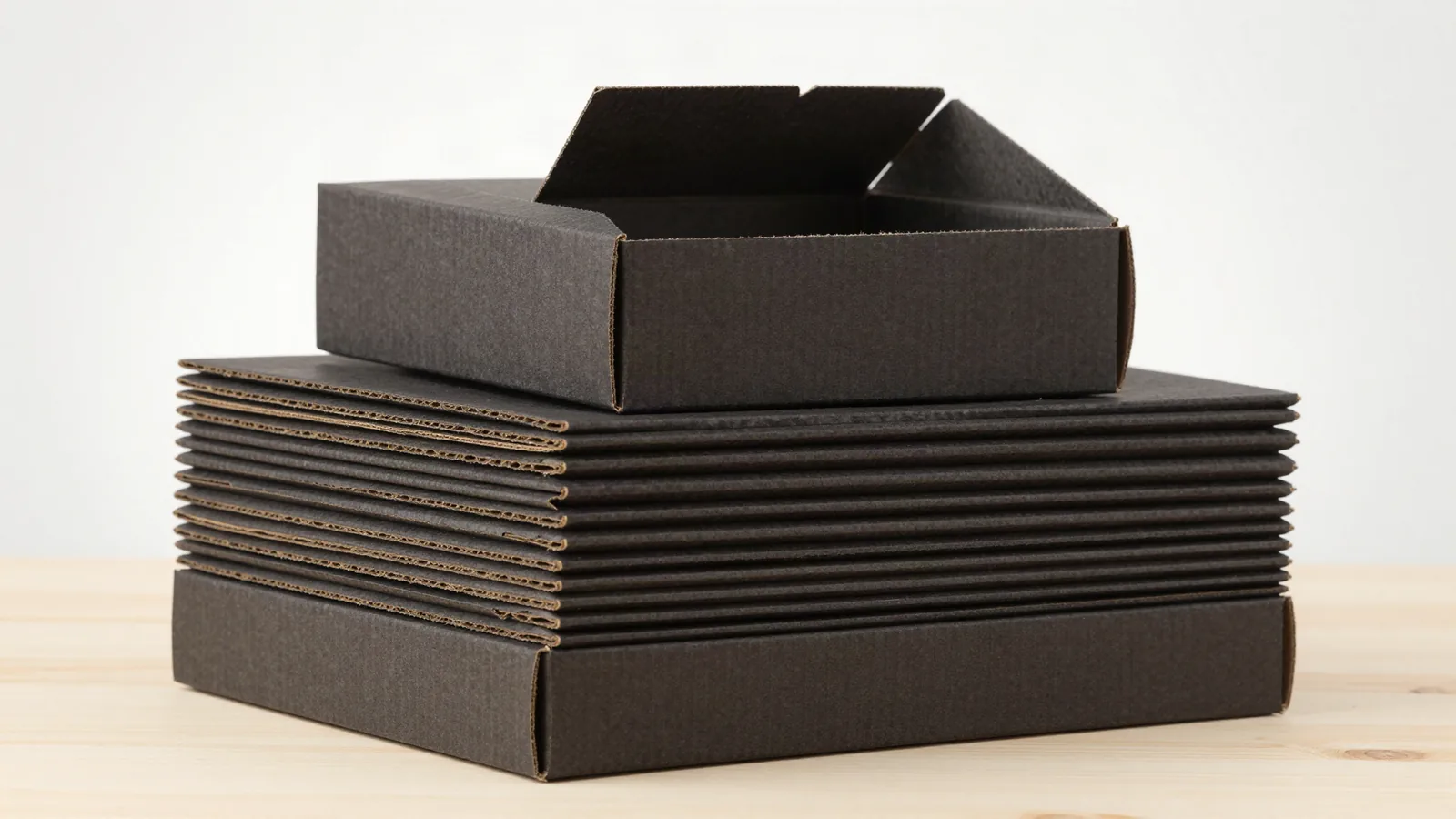




















































Corrugated flutes are wave-shaped paper medium between liner sheets. The profile changes board thickness, fold behavior, print surface, inside clearance, and how a package handles pressure. Buyers comparing mailers, cartons, outer shippers, and printed delivery packaging can review custom corrugated mailer boxes, corrugated boxes, and cake corrugated boxes. For a volume route, see wholesale custom packaging.
What does a corrugated flute control?
The flute is the shaped paper layer between liner sheets, and its height changes the board's caliper, crease behavior, face smoothness, and space inside the finished box. ECT means edge crush test, a board-strength reference that describes resistance at the edge of a sample.
| Flute reference | Typical industry caliper reference | Practical effect |
|---|---|---|
| E flute | About 1/16 in (1.5 mm) | Fine creases, smoother print face, less interior space used |
| B flute | About 1/8 in (3.2 mm) | More board depth for general cartons and dividers |
| C flute | About 3/16 in (4.8 mm) | Thicker wall and more cushioning potential for larger parcels |
| 32 ECT | Edge crush test reference | Compare with flute, board construction, box size, and stacking path |
These caliper references are typical industry values and can vary by mill and board construction. A thicker flute takes more room inside a fixed footprint, while a finer flute leaves more room for product and insert clearance.
Which corrugated flute fits my package?
A printed mailer with tight folds is usually checked against E flute, a general carton may start with B flute, and a larger outer shipper may need the added thickness of C flute. E flute gives the printer a finer face and sharper crease detail. B flute gives more board depth without the full thickness of C flute. C flute can add cushioning space, but it also changes outside dimensions and flap geometry.
Choose the profile beside the packed product, closure, stacking path, and carrier route. A flute letter alone does not specify the finished box.
Which corrugated structure fits the package?
FEFCO 0427 identifies a roll end tuck top mailer structure with a built-in opening and closure sequence. An auto-lock bottom changes how the base forms during packing. A crash-lock bottom uses a different folded locking path. Straight tuck end and reverse tuck end cartons can suit compact inner packs when the closure and loading direction are clear.
Draw the structure after the product arrangement is known. Glue tabs, scores, flap overlap, and hand access need to work together, especially when an insert or sleeve sits inside the box.
How should corrugated packaging be printed?
Flexo prints directly on corrugated board, while offset CMYK usually prints a separate sheet that can be mounted to the board, and digital printing can suit a short run or artwork version test. Each method changes the way ink sits around scores, seams, glue zones, and cut edges.
Matte or gloss lamination, soft-touch, spot UV, foil stamping, embossing, and debossing need a surface review before approval. Mark the reading side, fold lines, glue areas, and ink coverage on the dieline. RGB artwork can shift when converted for press, and type set too close to a score can become difficult to read after folding.
How do dimensions affect corrugated shipping?
Use inside length x width x depth for the packed contents, then record the assembled outside dimensions for the shipping package. A common packaging convention allows about 1/16 in, or 1.5 mm, tolerance, subject to the structure and product. Board caliper, flap depth, insert thickness, and closure geometry can change the finished outside size.
US ground carrier dimensional weight commonly uses L x W x H / 139. Void space therefore belongs in the shipping check, not only the printed face review.
How should I use a 32 ECT reference?
32 ECT is an edge crush test reference, not a complete box specification. Put it beside the flute, liner direction, outside size, closure, packed weight, stacking path, and delivery route so the comparison describes the actual package.
The same 32 ECT reference can behave differently when box geometry, board combination, or load direction changes. Ask for the board construction and finished dimensions together.
What drives the cost of a corrugated package?
Flute and board caliper affect paper use and converting. Print coverage, finishing, quantity breaks, tooling, shipping zone, dimensions, closure, and the selected structure also change the quote. A window, special lock, litho-laminated face, or custom insert adds another production decision.
Compare options with the same artwork, dimensions, finish, quantity, and destination. Otherwise the apparent price change may come from a different scope.
What should I put in a corrugated flute brief?
The brief should name the contents, packed arrangement, inside dimensions, outside parcel size, void space, flute, liner direction, structure, print method, finish, artwork status, quantity, destination, and handling route.
- Compare E, B, or C flute with any 32 ECT reference.
- Identify a mailer, auto-lock bottom, crash-lock, straight tuck end, reverse tuck end, or outer shipper.
- Mark scores, seams, glue zones, fold direction, and the panel that will be read.
- State whether the face needs flexo, offset CMYK, digital, lamination, soft-touch, spot UV, foil, embossing, or debossing.
CPL quotes to spec from a 100-unit minimum. Pricing is from $0.49 per unit at volume, quoted to spec. Production is typically 8 to 10 business days after proof approval, plus delivery. Free US shipping, free design support, and a free dieline are available. The $19.99 sample kit is credited to the first order.
Frequently Asked Questions
What are corrugated flutes?
Corrugated flutes are the shaped paper layer between liner sheets. E flute is a finer profile, B flute adds more board depth, and C flute is thicker. The profile affects crease behavior, print surface, inside clearance, and outside dimensions. The package structure, packed product, closure, and handling route still belong in the specification.
When is E flute commonly considered?
E flute is commonly considered for a lower-profile corrugated package where fine crease detail and a smoother printed face matter. The buyer should still check product clearance, insert thickness, closure geometry, outside dimensions, and shipping conditions. E flute does not define the finished mailer by itself.
How is 32 ECT different from a flute letter?
A flute letter describes the shape and approximate height of the corrugated medium, while 32 ECT is an edge crush test reference for board strength. A shipper comparison should list both beside the board construction, box dimensions, closure, packed weight, and stacking path.
How should I measure a corrugated shipping box?
Measure the packed contents using inside length x width x depth, then record the assembled outside dimensions. A common packaging convention allows about 1/16 in, or 1.5 mm, tolerance, subject to the structure and product. US ground dimensional weight commonly uses L x W x H / 139, so outside size belongs in the brief.
Which printing methods work on corrugated packaging?
Flexo prints directly on corrugated board, offset CMYK can print a separate sheet or litho-laminated face, and digital printing can suit a short run or artwork version test. List the print surface, ink coverage, scores, seams, glue areas, closure, and any lamination, soft-touch, spot UV, foil, embossing, or debossing separately.












