




























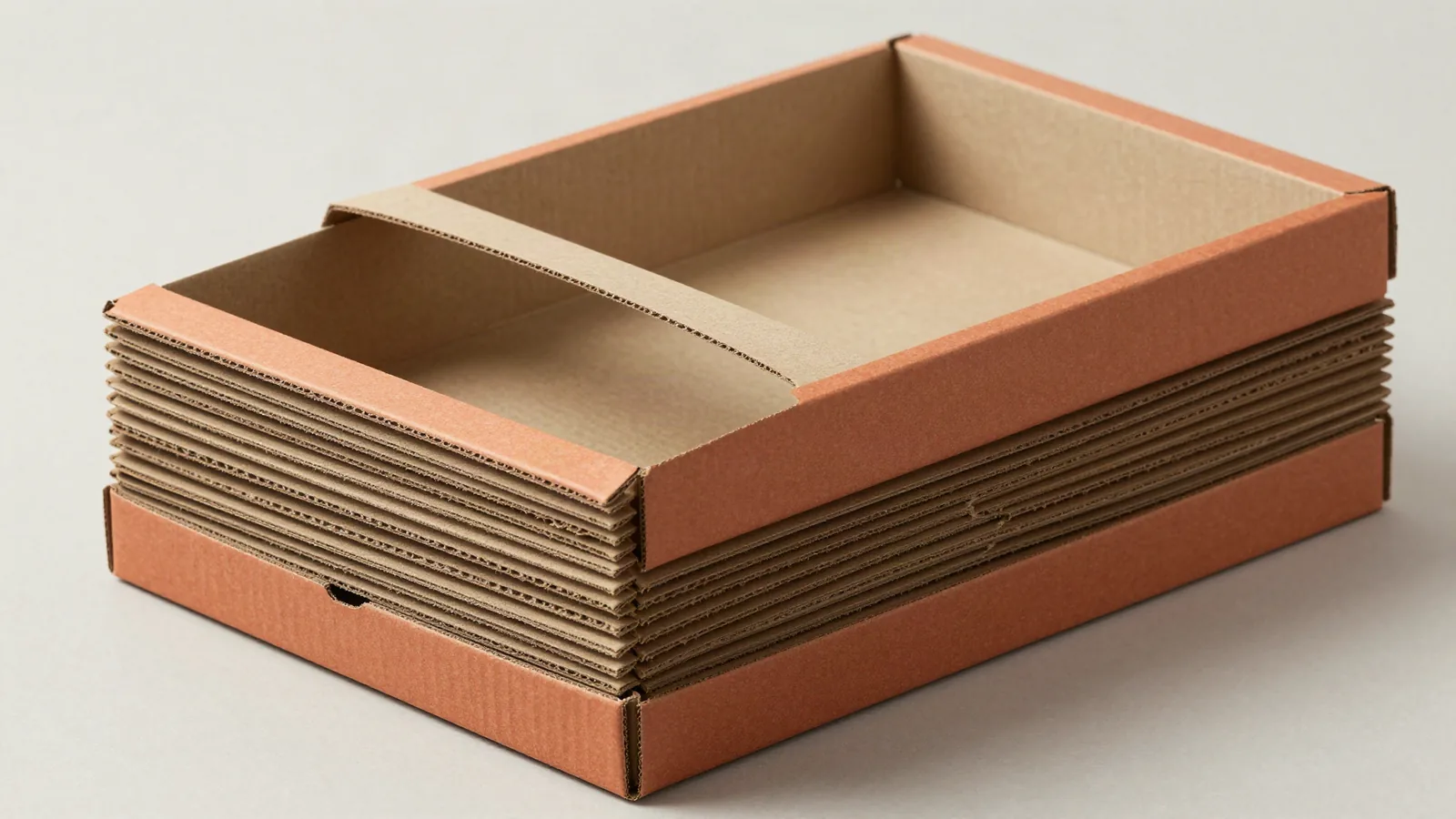




















































The board profile decides how a corrugated carton folds, prints, stacks, and protects the item inside. Corrugated paper is made from flat liner papers with a fluted medium between them, so the board has both a print-facing surface and a shaped interior. That construction affects the finished carton before ink or finish enters the job. A carton that looks right on a flat sheet can still lose clearance at a score or close badly after the product and insert are in place.
Use inside measurements when fit matters. The usual order is length x width x depth, with the product cavity kept separate from outside dimensions used for storage and carrier planning. About 1/16 in (1.5 mm) is a common planning tolerance, but the final fit depends on board construction, score placement, closure design, and how accurately the item sits in the carton.
Which corrugated flute should a carton use?
E flute keeps the profile compact and gives artwork a relatively fine surface. B flute adds profile and cushioning. C flute has a deeper profile, which can create more space between the liner faces and the packed item. A flute is the arched paper wave inside corrugated board, and its height changes the board's thickness and handling behavior.
| Board reference | Common use direction | Check before quoting |
|---|---|---|
| E flute | Compact cartons and presentation-led formats | Profile, print surface, and cavity clearance |
| B flute | Balanced profile and cushioning | Product weight, stacking pattern, and fold space |
| C flute | Deeper profile for shipping-oriented cartons | Outside size, headroom, and handling route |
| 32 ECT | Edge crush test reference | Board grade, footprint, and stacking pattern |
32 ECT is a common edge crush reference for corrugated board. It does not describe the finished carton by itself. The footprint, closure, product weight, stack pattern, and shipping environment still belong in the same specification.
How should corrugated carton artwork be printed?
Flexographic printing is a common direct process for corrugated surfaces. Offset CMYK fits a smoother liner or paperboard component when the design needs finer image detail, while digital printing can suit short runs or versioned artwork. Ink coverage, flute profile, contrast, and the distance at which the panel will be read all affect the choice.
Prepress catches the expensive mistakes. RGB artwork can shift when it is converted for press, low-resolution art can show jagged edges, and type set too close to a score can disappear into a fold. Leave bleed beyond the cut line. The digital proof should show the flat layout and the assembled carton. Mark every panel that remains visible after folding.
Matte or gloss lamination changes reflection across the printed face. Soft-touch changes the hand feel. Spot UV, foil stamping, embossing, and debossing need clean keep-out areas around folds, seams, and closure flaps. A finish that works on a flat panel may land badly on a score or corner.
Which carton structure fits the opening?
A straight tuck end keeps the opening simple, while a reverse tuck end changes which flap carries the visible seam. An auto-lock bottom or crash-lock bottom moves more work to the base and changes how the carton is filled. Choose the closure after the product orientation and loading path are clear.
A roll end tuck top mailer, commonly referenced as FEFCO 0427, uses a shaped end and a tuck top to create a mailer-style opening. A dieline is the flat cutting template for the carton. It should show cut lines, scores, glue tabs, bleed, and the panels that face out after assembly. The proof should show both the template and the folded result.
How do carton dimensions affect shipping?
Carrier planning uses the outside length, width, and height, even when the product fit uses inside measurements. For US ground carrier planning, dimensional weight commonly uses L x W x H / 139. That formula makes an extra inch of headroom a shipping decision, not only empty space inside the carton.
Keep the product cavity, finished carton, master carton, and pallet footprint as separate records. A carton can fit the item and still use too much space in a master carton. The outside dimensions also control storage and carrier calculations, so write both measurement sets on the brief.
What should you send with the carton artwork?
A useful brief fixes the packed item, board reference, print process, closure, and outside-size requirement before artwork is placed.
- Send product length, width, depth, orientation, and the inside cavity needed for fit.
- Name the flute direction, opening style, closure structure, and panels that must remain readable.
- Mark logo position, color priorities, ink coverage, bleed, and finish zones around scores and seams.
- Give the outside dimensions needed for storage, master-carton planning, and carrier calculations.
For related paper formats, compare printed paper bags, retail paper bags, paper bags with handles, and paper bags wholesale. For the broader route, see custom packaging solutions.
Customized corrugated paper for cartons is quoted from a 100-unit minimum. Pricing is from $0.49 per unit at volume, quoted to spec. Production is typically 8 to 10 business days after proof approval, plus delivery. Free US shipping, free design support, and a free dieline are available. Order the $19.99 sample kit; it can be credited to the first order.
Frequently Asked Questions
What does 32 ECT mean on a carton quote?
A 32 ECT carton uses a common edge crush test reference for corrugated board. ECT describes resistance to a controlled edge-crushing load, not the complete shipping result. Carton footprint, flute, closure, product weight, stacking pattern, and the delivery route still determine whether the selected board fits the job.
Can corrugated paper carry detailed artwork?
Corrugated paper can carry direct flexographic print, while offset CMYK can go on a smoother liner or paperboard component and digital printing can suit short runs or versioned artwork. Detailed artwork still needs enough contrast, suitable resolution, bleed beyond the cut line, and safe distance from scores, glue tabs, and closure flaps.
Why are inside and outside carton dimensions different?
Inside carton dimensions describe the cavity available to the packed item. Outside length, width, and height include the board thickness, folds, and closure, so they control storage and carrier calculations. A carton brief should record both sets because a correct product fit does not automatically produce an efficient master-carton or pallet footprint.
What does FEFCO 0427 describe?
FEFCO 0427 is a recognized reference for a roll end tuck top mailer structure. The code gives the box team a shared starting shape for the roll end, tuck top, scores, and closure panels. The final dieline still has to match the product dimensions, board choice, artwork, bleed, and opening direction.
How do scores and glue tabs affect a carton dieline?
Scores are the fold lines that guide the board during assembly, while glue tabs are the areas that join panels. Artwork set too close to a score can fold into the wrong face, and a logo placed on a glue tab can disappear during construction. The dieline should mark both areas before the digital proof is approved.












