




























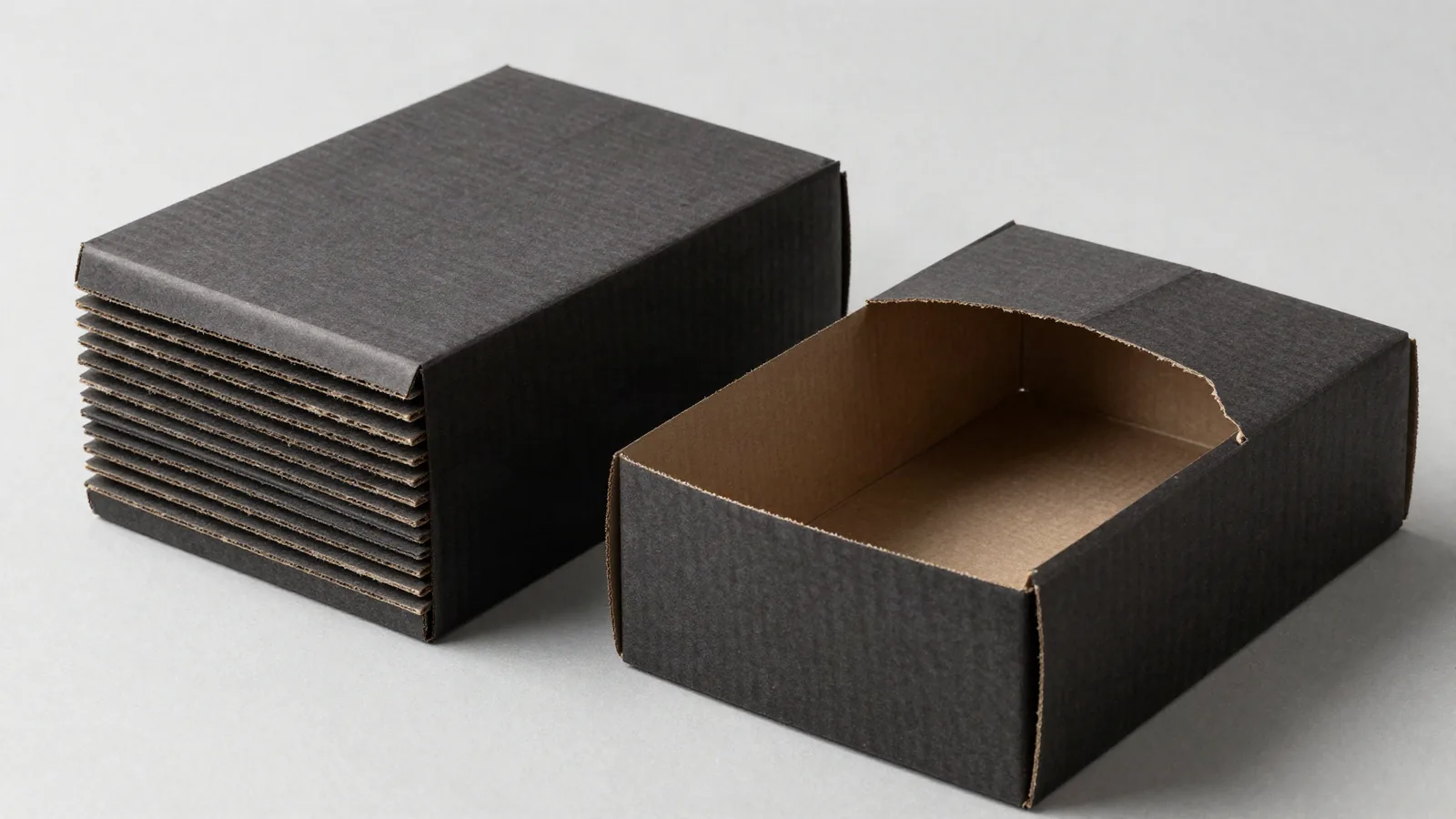




















































A custom corrugated shipper is a shipping box drawn around the packed product, its closure, the handling route, and the space needed for protection. It can hold one product, a kit, several smaller cartons, or a subscription-style assortment. The outer shipper may need a different job from a decorative retail package, so decide where branding belongs before adding inserts or changing board.
Corrugated board combines liner papers with a fluted medium. The flute profile changes thickness, print surface, cushioning potential, fold behavior, and the final outside dimensions. For a branded mailer format, see custom corrugated mailer boxes. For a broader packaging route, see custom packaging solutions.
Which flute should I choose for a shipper?
E flute takes less space and gives a finer printed face, B flute balances board depth with stiffness, and C flute adds thickness and cushioning potential. Typical industry caliper references are about 1/16 in (1.5 mm) for E flute, 1/8 in (3.2 mm) for B flute, and 3/16 in (4.8 mm) for C flute. Mill and board construction can change those references.
| Corrugated reference | Typical packaging role | What to assess |
|---|---|---|
| E flute | Finer profile and smoother print face | Product size, print coverage, and crush needs |
| B flute | Balanced stiffness and cushioning | Weight, void space, and stacking |
| C flute | More thickness and cushioning potential | Outside dimensions, storage, and handling |
| 32 ECT | Common edge crush test reference | Board specification and shipping conditions |
These are general industry references, not a complete shipper specification. Put flute, board combination, packed weight, box geometry, stacking path, and delivery conditions in the same comparison.
How do shipper structures change packing?
FEFCO 0427 identifies a roll end tuck top structure with a built-in opening and closure sequence. A regular slotted carton uses flaps that are commonly closed with tape. A tuck-top mailer puts the opening sequence on the package itself, while a standard shipper may favor direct packing, palletization, or more open interior volume.
An auto-lock or crash-lock bottom changes how the base forms. Scores, glue tabs, flap overlap, and hand access should be checked with the packed product in place. If a bottle needs internal organization, compare custom Woozy bottle boxes. Smaller products may point to custom vial boxes.
How do outer dimensions affect shipping?
Use inside length x width x depth for the packed contents, then record the assembled outside dimensions of the shipper. A common planning tolerance is about 1/16 in, or 1.5 mm. Product clearance, insert thickness, score placement, flap overlap, and closure geometry can change the final outside size.
US ground carrier dimensional weight is commonly referenced as L x W x H divided by 139. Excess void space can increase material use and dimensional weight. A box that is too tight can slow packing or place pressure on the contents.
How should I plan print and interior protection?
Flexographic printing puts ink directly on corrugated board. Digital printing can suit short runs or variable artwork. Offset CMYK is more often associated with a separate printed sheet or litho-laminated surface. Artwork should account for scores, flaps, seams, glue areas, and the panel visible when the package opens.
Corrugated pads, dividers, paperboard supports, and foam can limit movement inside the shipper. The insert should keep the product away from the walls without blocking closure. For candle-related packaging, compare custom votive candle boxes, then decide whether the required item is the product carton, the shipper, or both.
Should the shipper hold the product or a retail box?
A separate retail carton changes the shipper's interior dimensions, void space, and packing order. Measure the retail carton as packed, not only the product inside it. Direct-to-product shipping may need a pad, divider, or foam component that would be unnecessary around a finished retail box.
Write down the loading sequence and the orientation that the carton will occupy. That information affects insert placement, closure clearance, pallet layout, and the outside size used for carrier planning.
What should a shipper quote include?
The request should name the packed product or retail carton, product count, inside and outside dimensions, desired flute, 32 ECT reference if relevant, closure style, print coverage, insert needs, artwork, quantity, destination, and delivery route.
Use the sample kit to review board profiles, print, and construction before approving the proof.
CPL quotes to spec from a 100-unit minimum. Pricing is from $0.49 per unit at volume, quoted to spec. Production is typically 8 to 10 business days after proof approval, plus delivery. Free US shipping, free design support, and a free dieline are available. The $19.99 sample kit is credited to the first order.
Frequently Asked Questions
What is the difference between E, B, and C flute?
E flute has a finer profile and can support a smoother printed face. B flute adds board depth with a balance of stiffness and cushioning. C flute is thicker and can provide more cushioning potential. The choice also depends on product weight, box dimensions, stacking, void space, print requirements, and handling.
What does 32 ECT mean for a corrugated shipper?
32 ECT is an edge crush test reference for corrugated board. It should be considered beside flute, board combination, box dimensions, closure, packing pattern, packed weight, and shipping conditions. The number alone does not describe every performance factor, so the intended load and handling route belong in the specification.
How should I calculate shipper dimensions?
State the outer size as length x width x depth and record the inside dimensions separately. For US ground shipments, carrier dimensional weight is commonly referenced as L x W x H divided by 139. Product clearance, insert thickness, and closure geometry can change the final outer size, so measure the assembled shipper.
Can a corrugated shipper include a divider or insert?
A corrugated shipper can include pads, dividers, partitions, paperboard supports, or foam when the product needs movement control or wall clearance. The insert should be measured with the packed contents and checked against closure geometry. If the shipper contains a retail carton, measure that carton as packed before drawing the interior.
What artwork belongs on a corrugated shipper?
A corrugated shipper can carry a logo, handling message, opening instruction, or simple visual system on the exterior. Flexographic printing is commonly used for direct corrugated coverage, while digital printing can suit short runs or variable artwork. Artwork should leave room for scores, flaps, seams, glue areas, and the visible opening panel.












