




























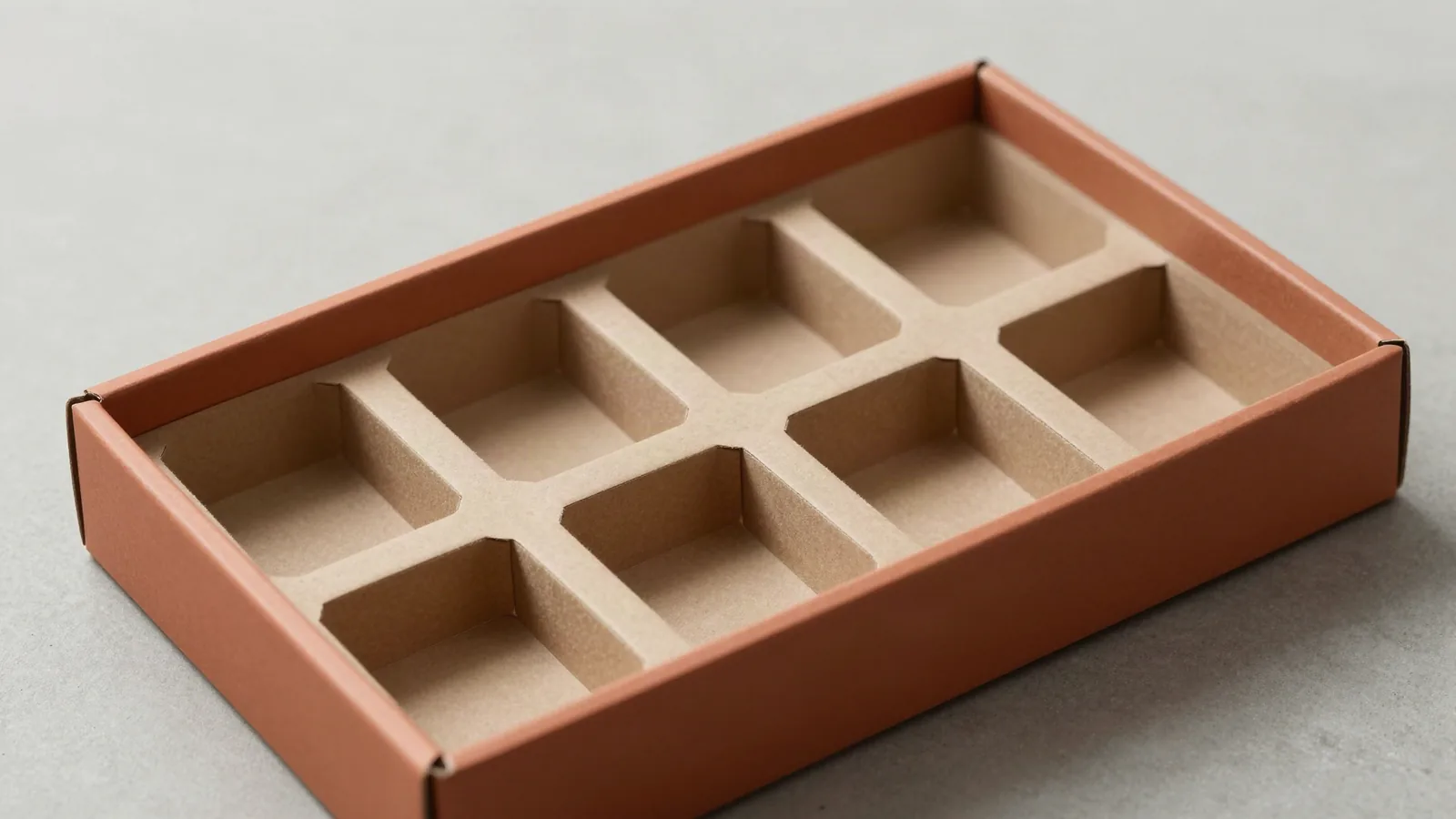




















































Custom Styro Foam Insert Boxes usually means an outer package paired with a shaped foam insert. In a buying brief, styro foam names the insert direction, not the carton style or finished size. A dieline is the flat cutting template for the outer box, with panels, scores, glue tabs, cut lines, and artwork-safe areas. Keep the shell and insert on the same job sheet. The shell can be folding paperboard, kraft, a mailer, a rigid box, or a drawer format. The insert then gets a cavity map, depth, finger access, and product orientation. Use custom mailer boxes with inserts, custom vial boxes, custom votive candle boxes, and custom Woozy bottle boxes as structure references.
What does a styro foam insert box include?
The quote has two coordinated parts: an outer shell that carries the print and a foam insert that positions or separates the product. An insert is the shaped interior piece cut with one cavity, several cavities, channels, edge supports, or a removable layer. State which surfaces need protection, display, touch, or access. The shell still needs its own closure, board, print, and finish plan. The cavity should never be drawn as an empty shape with no loading motion behind it.
Which outer structure should hold the insert?
A straight tuck end leaves the foam inside folding panels, while a mailer, rigid box, or drawer changes the loading motion and clearance. Use the structure comparison below as a planning guide.
| Outer structure | Common role | Insert planning point |
|---|---|---|
| Straight tuck end | Folding carton with top and bottom tucks | Reserve space for folds, locking panels, and cavity height |
| Mailer | Roll end tuck top, commonly referenced as FEFCO 0427 | Coordinate the insert with the opening and end panels |
| Two-piece rigid | Separate base and lid presentation | Set the insert against the base interior and lid clearance |
| Drawer or slide | Moving inner tray and outer sleeve | Protect the slide path and finger access areas |
How deep should the foam cutout be?
Cavity depth follows product height and the hand used to remove it. Start with the actual product or a reliable drawing. Record length, width, depth, round walls, caps, handles, seams, fragile surfaces, and any label or control that must stay visible. A rigid foam cutout holds a defined edge, so a cavity that stops too shallow can let the product sit proud of the box, while one that runs too deep can hide the grip area. Mark wall support, finger access, and the surfaces that may touch foam.
What measurements should I send?
Record length x width x depth, and label inside measurements separately from outside measurements. About 1/16 in, or 1.5 mm, is a common packaging planning tolerance. The correct allowance still depends on product variation, board caliper, foam behavior, cut method, and assembly. Mark clearance zones around closures, corners, seams, and parts that should not touch the product. The insert gets checked against usable interior space, not the outer panel size.
Which board materials pair with styro foam?
General folding-carton references include SBS, C1S, and C2S paperboard in a 12 to 24 pt range. SBS is solid bleached sulfate; C1S is coated on one side, and C2S is coated on two sides. Kraft board is often discussed in an 18 to 24 pt range. A rigid box may use 1.5 to 3 mm chipboard wrapped in 100 to 157 gsm art paper. Match board caliper to insert geometry, cavity pressure, wall height, closure, product weight, and opening direction. If a folding carton sits inside an outer shipper, size the two parts together.
Which CPL products can help me compare the packout?
The mailer page gives a shipping-oriented opening reference. The bottle page gives a taller product footprint, while the candle and vial pages show compact layouts with separated positions. Compare custom mailer boxes with inserts, custom Woozy bottle boxes, custom votive candle boxes, and custom vial boxes. The quote still needs the actual product drawing, cavity map, opening motion, and box dimensions.
Which print and finish choices belong on the shell?
Offset CMYK is a common reference for detailed paperboard artwork. Digital printing can suit a short run or a test direction. Matte or gloss lamination changes surface appearance, and soft-touch changes the hand feel. Spot UV, foil stamping, embossing, and debossing assign different jobs to selected panels. Put folds, glue areas, foam openings, bleed, and artwork-safe zones on the proof. RGB art can shift after press conversion. Type too close to a score can be folded. A finish that crosses an opening should be checked against the foam cutout before the file is approved.
What should I check before approving the proof?
The proof is the last inexpensive place to catch a fit or artwork error. Check cavity count, depth, finger access, product orientation, panel order, folds, glue areas, closure, artwork-safe zones, and finish placement. Put the actual product or a dependable drawing beside the dieline. Check that an insert does not cover required text, block the opening, or change the visible product area. The clock starts at proof approval, not at the first request.
Custom Packaging Lane quotes styro foam insert boxes to spec from a 100-unit minimum. Pricing is from $0.49 per unit at volume, quoted to spec. The quote also reflects the outer structure, foam layout, board, print coverage, finishing, quantity, tooling, and shipping scope. Production is typically 8 to 10 business days after proof approval, plus delivery. Free US shipping, free design support, and a free dieline are included in the quoted scope. The $19.99 sample kit is credited to the first order. Send the packout through custom packaging for small business.
Frequently Asked Questions
Does styro foam describe the box or the insert?
Styro foam describes the insert direction in a packaging brief, not a single outer box style. The shell may be a folding carton, mailer, rigid box, or drawer format. Specify the outer structure separately from the foam cavity, then connect both to the product dimensions, opening motion, cavity depth, and visible surfaces.
How does a mailer differ from a rigid outer box?
A mailer opens through a roll end tuck top and keeps the insert inside a parcel-oriented shell. A two-piece rigid box separates a base and lid, so the insert sits against the base interior and needs lid clearance. The opening, assembly, slide path, and artwork panels change with the shell.
What changes when several products share one insert?
Several products in one insert need a cavity map that shows each position, orientation, depth, accessory, and removal path. Mark fixed cavities separately from interchangeable sections. The outside box also needs enough height for the full foam stack, cards, caps, dividers, and closure movement.
Can I use digital printing on a styro foam insert box?
Digital printing can suit a short run or a test direction on the outer shell. Offset CMYK is a common reference for detailed paperboard artwork. Decide the print route after the shell, board, ink coverage, and finish areas are known. The proof should show folds, glue areas, cavity openings, and safe artwork zones.
What should the final proof show?
The final proof should show the outer dieline, cavity count, depth, finger access, product orientation, folds, glue areas, closure, artwork-safe zones, and finish placement. Compare it with the actual product or a dependable drawing. Check that the insert leaves required text visible and does not block the opening.












