
























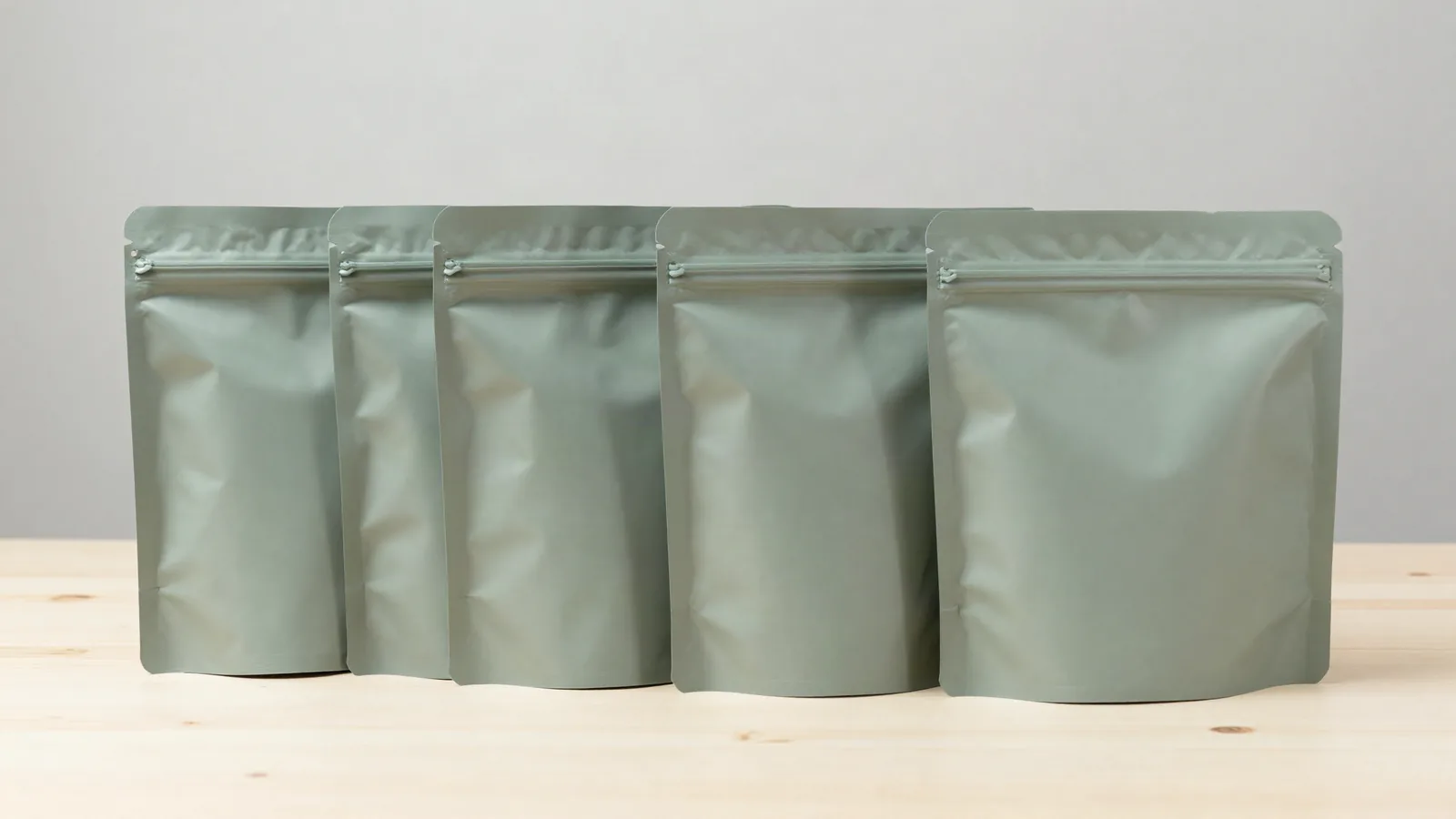








































Heat seal Mylar bags are flexible bags closed by pressing heat across the open edge. The inner seal layer bonds at the mouth, while the outer film and barrier layers support the printed package. Buyers searching for heat sealed Mylar bags, Mylar bag heat sealing, or resealable vs heat seal Mylar bags usually need the construction and opening method defined before artwork is approved.
What does a heat-seal specification need to identify?
A heat-seal specification needs the bag dimensions, layer order, film gauge, inner sealing surface, seal location, clear seal area, opening direction, and closure details. A dieline is the flat cutting template that shows the bag shape, trim, seal zone, and artwork limits. The seal zone is the strip of material reserved for the joined edge. Keep these fields together because the product name alone cannot describe how the finished bag will close.
| Closure format | How the buyer opens it | Details to confirm |
|---|---|---|
| Heat seal | Cut or tear across the sealed edge | Inner layer, seal area, gauge, opening direction |
| Zipper bag | Open and close an interlocking track | Zipper position, headspace, seal edge, artwork clearance |
| Vacuum-seal bag | Remove air, then seal the mouth | Bag size, equipment sequence, seal area |
A good record also shows where the product stops before filling and where a tear notch or cut line begins. Those small details keep the opening method from colliding with artwork or product fill.
Which film layers are used in a heat-seal Mylar bag?
Custom Packaging Lane's heat-seal bag description names PET, aluminum, and PE in a three-layer direction. PET is the outer film direction, aluminum supplies the metallic barrier layer, and PE is the inner sealing direction in that construction. A laminate is a bonded stack of film layers. Confirm the exact layer order and selected gauge in the quote because a product label is not a complete film specification.
The seal depends on the inner surface facing the matching surface at the mouth. Artwork belongs on the specified print surface, and the barrier layer must stay in the selected position throughout the bag. Ask for the layer order in plain language before approving the proof.
How should you choose a Mylar bag gauge?
CPL's public Mylar guidance groups 3 to 5 mil for lighter items, 7 mil as a middle planning point, and 10 mil or higher for heavier-duty storage. Mil is a thickness unit equal to one-thousandth of an inch. These bands organize the material discussion, but they do not replace the exact gauge in a quote.
Gauge changes the bag's feel, folding, seal behavior, handling, and quoted cost. A thicker bag is not automatically the right bag for a tight fill or a small opening. Match the gauge to the product, bag dimensions, closure, and packing method.
What does seal strength depend on?
Seal strength is the resistance of a finished sealed edge to opening under the conditions of the job. It depends on the inner sealing layer, gauge, seal width, temperature, pressure, dwell time, contamination, and fill position. Dwell time is how long the heated jaws hold the material together.
A bag filled into the seal area can weaken the closure even when the film choice is correct. During a sample check, keep the product below the seal path, close the bag in the planned orientation, and inspect the joined edge from corner to corner. State the construction and packing conditions before asking for performance information.
Which CPL Mylar bag format fits the project?
Custom Mylar heat seal bags are the direct format for a sealed edge. Custom Mylar vacuum seal bags fit projects where air removal is part of packing. Mylar bags for freeze drying provide a storage-focused reference, and custom printed Mylar bags keep artwork in the same discussion as film and closure.
Use the product page that matches the packing sequence. A vacuum-seal job needs an air-removal step, while a standard heat-seal job centers on the edge closure and first-opening method.
What should the proof confirm before approval?
The digital proof should confirm the flat dimensions, filled shape, layer description, gauge, seal position, seal width, tear direction, artwork coverage, clear area, and any trim or bleed. A digital proof comes before anything prints. If the package may touch the product, ask us about food-contact options.
Custom orders have a 100-unit MOQ. Pricing is from $0.49 per unit at volume, quoted to spec. Production is typically 8 to 10 business days after proof approval, plus delivery. Free US shipping and free design support are available. Order the $19.99 sample kit to compare film feel and closure direction, then review wholesale custom packaging for the broader order route.
Frequently Asked Questions
How do heat sealed Mylar bags differ from resealable bags?
Heat sealed Mylar bags close across the mouth and are normally opened by cutting or tearing the sealed edge. Resealable Mylar bags use an interlocking zipper for repeated access. A quote should identify the closure, seal location, zipper position, headspace, gauge, and artwork clearance for the exact bag format before production begins.
What determines the strength of a heat seal?
Heat-seal strength depends on the inner sealing layer, film gauge, seal width, temperature, pressure, dwell time, contamination, and fill position. A heat sealed Mylar bag needs those conditions defined with the construction before performance information can be assessed. Keep product fill away from the seal area during testing.
Which Mylar gauges can CPL discuss?
CPL's Mylar guidance groups 3 to 5 mil for lighter items, 7 mil as a middle planning point, and 10 mil or higher for heavier-duty storage. Mil means one-thousandth of an inch. The exact gauge still depends on the bag dimensions, layers, closure, handling, and product.
Are vacuum-seal bags the same as heat-seal bags?
Vacuum-seal bags and heat-seal bags can both close with a heated edge, but vacuum-seal bags also require air removal as part of the packing sequence. Custom Packaging Lane should receive the equipment and packing method so the bag dimensions, seal area, and opening record match the job.
What are the order terms for custom heat seal Mylar bags?
Custom heat seal Mylar bags have a 100-unit MOQ. Pricing is from $0.49 per unit at volume, quoted to spec. Production is typically 8 to 10 business days after proof approval, plus delivery. Free US shipping, free design support, and a $19.99 sample kit are available.