




























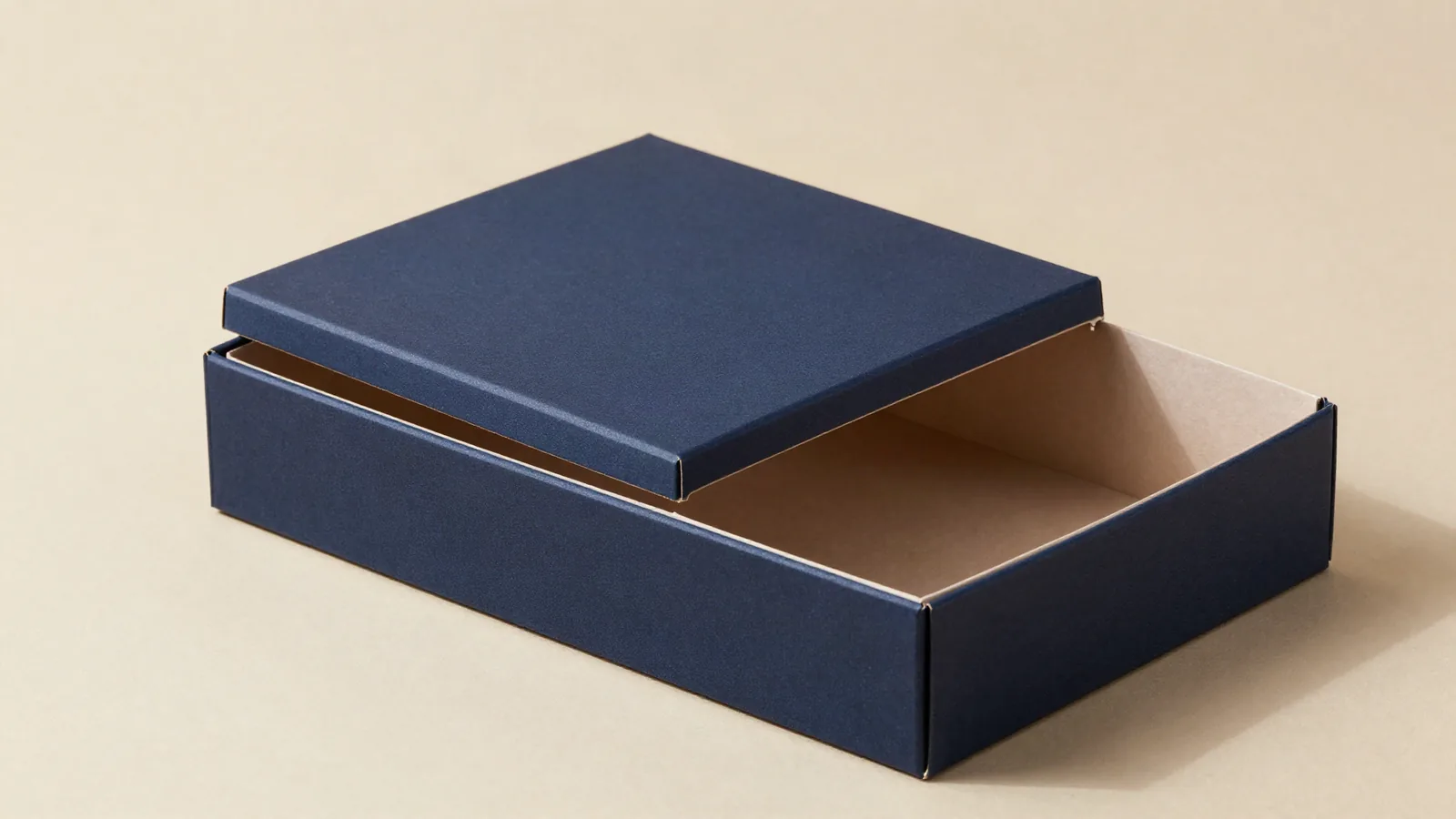




















































What gives a rigid box a luxury feel?
The shell stays square in your hands because a rigid box is built from chipboard wrapped in printed or colored paper. Chipboard is dense paperboard that supplies the box's shape; the wrap carries color, artwork, and surface treatment. A common trade range is 1.5 to 3 mm chipboard with 100 to 157 gsm art paper. Thicker board adds stiffness and weight, but it also changes the fit of the lid, tray, and insert. Folding cartons rely on scored paperboard and fold flat. Rigid boxes are built to hold their shape.
Opening motion matters as much as board. A two-piece rigid box separates a base and lid for a lift-off reveal. A drawer or slide box moves a tray through a sleeve. A magnetic flap closes like a book. A sleeve and tray puts an outer cover around a visible inner tray. Choose the motion from the product's proportions and how the buyer will remove it. See custom luxury rigid boxes when the box needs to carry the presentation.
Which rigid box structure fits the product?
The product's opening direction should decide the structure. A two-piece box gives a direct lift, a drawer gives a guided pull, and a sleeve-and-tray format keeps the outer cover separate from the tray.
| Structure | Opening motion | Useful when |
|---|---|---|
| Two-piece rigid | Lift-off reveal | The lid and base need separate surfaces |
| Drawer or slide | Pull-out reveal | The product should appear progressively |
| Magnetic flap | Book-like opening | The box needs a hinged presentation |
| Sleeve and tray | Outer sleeve removal | The tray should remain visible after opening |
Specify the inside length x width x depth, then add the product, insert, and wrap thickness to the fit discussion. A tolerance is planned clearance between the packed item and the inside wall. A common packaging convention allows about 1/16 inch, or 1.5 mm, but the correct fit depends on product geometry. A shoe box packaging project may need room for access and stacking, while wine box packaging may need an interior that keeps the contents oriented.
A shallow tray puts a flat item near the opening. A deeper base suits a taller product or a layered set. If the box stands upright, specify side support or a fitted platform. The lid, tray, and insert should meet cleanly when open, with only the clearance the product needs. Towel packaging is another useful reference when soft goods need a neat presentation inside a rigid structure.
How should print and finish be planned?
Offset CMYK is a four-ink print process used for detailed graphics on the wrapped surface. Matte lamination cuts reflected glare; gloss lamination gives the surface more shine. Soft-touch adds a smoother hand feel. Spot UV puts a hard glossy patch on selected artwork, while foil stamping adds a metallic mark. Embossing raises artwork and debossing presses it into the wrap. Keep each effect tied to a panel, because coverage and registration change around folds, corners, and wrapped edges.
A press check looks at solid color, small type, fine lines, and registration between print and finish before the run proceeds. Keep type away from scores and glue tabs, and leave bleed beyond the cut edge. A digital proof catches those file problems before anything prints. Low-resolution art, RGB color conversion, missing bleed, or type placed over a score can force a correction after the dieline has already been prepared.
What should buyers confirm before ordering?
The dieline should be drawn from the packed product, not a guessed box size. A dieline is the flat cutting template used to print, cut, score, and wrap a package. Send product length, width, depth, count, weight, opening direction, and insert details. Also specify board thickness, wrap paper, print coverage, and finish areas. Ask us about food-contact options for your product. Child-resistant construction can be built when the application needs that feature, but the feature should be scoped for the specific use.
- Confirm inside dimensions and product clearance.
- Identify every printed panel and finishing area.
- Choose whether the box should be reusable or presentation-only.
- Check a physical sample before approving production artwork.
Custom Packaging Lane provides free design support and a free dieline. Quotes start at a 100-unit minimum, with pricing from $0.49 per unit at volume, quoted to spec. Production is typically 8 to 10 business days after proof approval, plus delivery. Free US shipping is available, and the $19.99 sample kit is credited to the first order. Start with custom packaging design and send the product dimensions for the first proof.
Frequently Asked Questions
What materials make up luxury rigid box packaging?
Luxury rigid box packaging commonly uses 1.5 to 3 mm chipboard wrapped in 100 to 157 gsm art paper. Chipboard supplies the shell, while the paper wrap carries printed color, texture, and finish. The construction can then be formed as a two-piece rigid box, drawer or slide box, magnetic flap, or sleeve and tray.
Which finish should I choose for a rigid box?
Matte lamination lowers reflected glare, while gloss lamination gives the printed surface more shine. Soft-touch changes the hand feel. Spot UV adds a glossy patch, foil stamping adds metallic detail, embossing raises artwork, and debossing presses it into the wrap. Place effects around scores, corners, glue tabs, and opening surfaces.
How do I size a rigid box for my product?
To size a rigid box, provide the product's inside length x width x depth, then account for the insert, wrap thickness, and removal clearance. A common packaging convention allows about 1/16 inch, or 1.5 mm, tolerance, but product geometry controls the final fit. Check the assembled box with the actual product before approving artwork.
Can rigid boxes include inserts?
Rigid box inserts can center one item, divide a set, or create a shaped cavity. The insert changes the usable inside dimensions, so specify its material, thickness, contact points, and removal method before the dieline is finalized. A tray, partition, or fitted platform each changes how the product sits and how much clearance the lid needs.
How should I compare rigid box options?
To compare rigid box options, prepare the product dimensions, quantity, structure, artwork panels, board range, finish, insert needs, and shipping destination. A physical sample lets you check the board feel, wrap, fit, opening motion, and finish under real handling. That information gives the quote a defined structure instead of a vague request for a luxury box.












