




























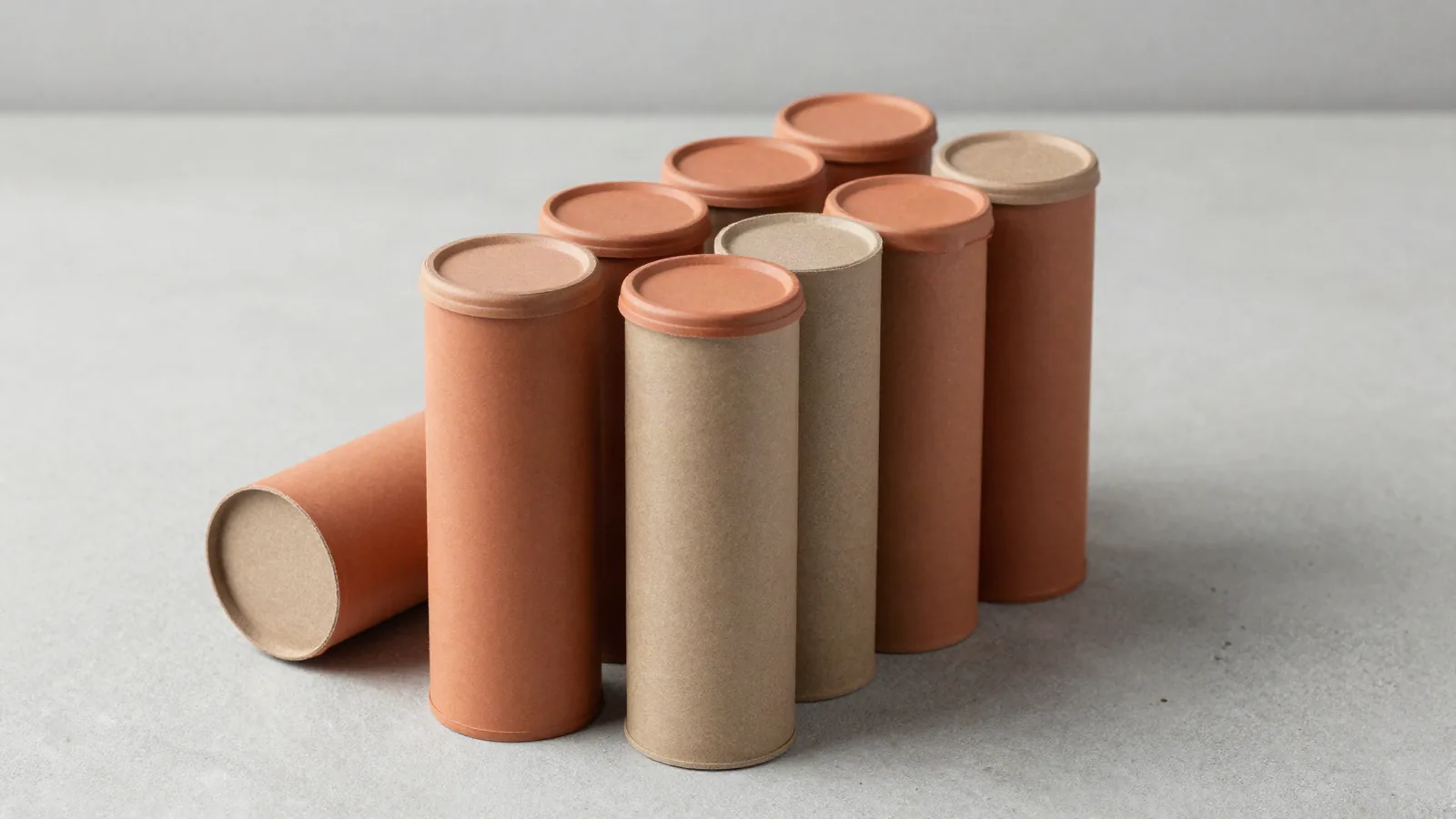




















































A paperboard tube package is a round paperboard body with a printed wrap, cap, sleeve, or inner component around a product. Its working dimension is usually the inside diameter, because the product must enter without catching and still come back out after filling. A dieline is the flat cutting template for the wrap or component. Start with the product and loading path, then place the label panels. Review cookie tube packaging, cardboard tube packaging, and candle tube packaging as catalog references.
Which products fit a paperboard tube package?
A round product often makes the tube sensible, but diameter alone does not settle the package. Cookies need a clear loading path and internal spacing. Candles need vessel fit, cap clearance, and a base that sits flat. A gift item may need an insert or accessory card. The product shape should decide the tube before artwork is drawn.
| Product program | Packaging question | Physical check |
|---|---|---|
| Cookies | How does the product enter without catching the wall? | Check inner diameter, loading path, and base stability |
| Candles | Does the vessel and cap stay aligned? | Check wall clearance, cap retention, and surface contact |
| Gift item | Where do the product and card sit? | Check insert position and removal sequence |
| Seasonal version | Which artwork panels change? | Check seam placement and approved version name |
What should a cookie tube brief record?
Cookie tubes need the loading sequence written before the printed wrap. Record cookie diameter, stack or arrangement, inner wrap, headspace, base, top opening, and loading direction. Headspace is the open room above the product stack. A friction-fit cap is held by pressure against the tube wall; a telescoping lid overlaps the body. A sleeve changes the usable height and opening motion. Show seam, closure overlap, and label area in the proof.
Check the tube with the actual stack, not an empty cylinder. If a card or divider is included, draw its position separately. The packer should be able to open, load, close, and remove the stack without catching the wall.
How should a candle tube fit the vessel?
Vessel and lid clearance determine whether a candle tube opens cleanly. A vessel is the jar or container holding the candle. Record its outside diameter, height, lid, protective wrap, insert, and loading direction. A tube can use a separate cap, a lid and base, or a sleeve around an inner container. Check the closure with the actual vessel because overlap changes usable height, opening force, and printed panel alignment.
What wall and wrap materials should you specify?
Construction controls roundness, wall feel, and the space left for the product. Folding paperboard components can use SBS, C1S, or C2S board in the 12 to 24 pt range. Kraft board commonly falls in the 18 to 24 pt range. A rigid tube construction can use 1.5 to 3 mm chipboard wrapped in 100 to 157 gsm art paper. GSM means grams per square meter, a paper weight reference.
State whether the package is a wrapped rigid body, a folding paperboard sleeve, or a paperboard shell around another component. Include the cap, base, wrap overlap, and any insert in the same drawing. A wall specification without the closure leaves the usable height unclear.
Which print finishes work on a curved tube?
Offset CMYK suits detailed printed wraps. Digital printing can suit a short run or a version test. Matte or gloss lamination changes reflectivity. Soft-touch changes the surface feel. Spot UV can isolate a logo or vertical panel. Foil stamping, embossing, and debossing change surface contrast. Mark the seam, cap edge, overlap, scores, and any area that curves around the product.
Curved artwork should be checked in its wrapped position, not only as a flat file. Low-resolution art shows quickly on a vertical panel, and RGB art can shift when it is converted for press. Keep type clear of the seam and closure. We send a digital proof before anything prints, so orientation and finish zones can be checked on the actual tube layout.
What should a paperboard tube sample prove?
A useful sample is full of the real product, not an empty cylinder. Check that the product loads without catching, the wall stays round, the cap retains correctly, and the base sits flat. Inspect the seam and label area after the tube is filled. Then repeat the opening and closing motion. A card, divider, or insert should come out with the product only when that is the intended pack-out.
What should I send for a tube-package quote?
Send dimensions and the loading sequence in one request.
- List the cookie stack, candle vessel, gift item, or other product, with its wrap and clearance.
- Name the body, cap, sleeve, base, insert, seam position, and printed panels.
- State board, chipboard, art paper, lamination, spot finish, foil, embossing, or debossing needs.
- Attach artwork or mark it as pending, then identify the version and destination.
- Describe any outer package separately. Do not assume the tube is the shipping carton.
Custom Packaging Lane quotes paperboard tube packages to spec from a 100-unit minimum. Pricing is from $0.49 per unit at volume, quoted to spec. Production is typically 8 to 10 business days after proof approval, plus delivery. The quote includes free US shipping, free design support, and a free dieline. Order the $19.99 sample kit, credited to the first order, then send the product dimensions and artwork status. For artwork planning, see custom packaging design.
Frequently Asked Questions
When is a tube better than a folding carton?
A paperboard tube can suit a cookie, candle, gift item, or other product with a round profile and a narrow vertical presentation. The decision still depends on loading direction, inside diameter, cap or sleeve, base, insert, and removal path. Test the actual product because an empty tube does not show wall clearance or closure behavior.
How much clearance does a cookie tube need?
Cookie tube clearance is set by cookie diameter, inner wrap, stack arrangement, wall, base, and cap. No single clearance works for every cookie tube. Record the product dimensions and loading path, then check a filled sample. The sample should show whether the stack enters without catching, stays aligned, and comes out without damaging the wrap.
What is a friction-fit cap?
A friction-fit cap is held closed by pressure between the cap and the tube wall. Its opening feel depends on cap overlap, wall construction, product clearance, and how the packer grips it. A tube proof should show the cap edge and closure overlap, then be checked with the filled product rather than by handling the empty package.
What does 100 to 157 gsm mean for a tube wrap?
100 to 157 gsm describes the paper weight range for art paper wrapped around a rigid chipboard tube. GSM means grams per square meter. The wrap paper affects print appearance, surface feel, seam placement, and how the tube curves. The chipboard body and the wrapped paper should be checked together because both affect the final diameter and closure fit.
Why does curved artwork need a wrapped proof?
Curved artwork needs a wrapped proof because a flat file cannot show seam alignment, overlap, cap-edge position, or how type sits around the tube. A wrapped check also exposes low-resolution art and RGB color shifts after press conversion. Inspect the actual tube with the finish zones, label panel, closure, and product loading path in place.












