










































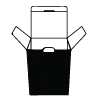

A sleeve box dieline is the flat cutting template for a wraparound sleeve. The printer uses it to place artwork, cut edges, score fold lines, and mark the overlap around a tray or inner box. Start with the finished outside dimensions of the component the sleeve covers. A sleeve that fits the front panel but ignores the side, overlap, or opening can bind during assembly.
What is a sleeve box dieline?
A sleeve box dieline is a connected flat layout of front, back, side, overlap, and opening areas. It shows how the sleeve folds around the inner package, where the edges meet, and which panels carry the artwork. The dieline is a working production file, not a decorative rectangle. Use CPL's supplied template as the dimensional source.
Which measurements belong in a sleeve box request?
Send the finished outside length, width, and height of the tray or inner box, plus the opening direction and any insert that stays inside. Measure the assembled component, not only the product before it enters the tray. If the inner package has a foam insert, lid, raised edge, or irregular corner, include its outer shape in the brief.
| Dieline area | Input to provide | Production consequence |
|---|---|---|
| Front and back panels | Visible faces and artwork direction | Controls orientation on the assembled sleeve |
| Side panels | Turn points and panel width | Prevents corner and fit errors |
| Overlap | Where the sleeve edges meet | Keeps closure and glue notes in the right area |
| Opening | Slide direction and tray reveal | Matches assembly with the intended opening action |
| Inner component | Outside dimensions and insert shape | Prevents binding or excess movement |
How does panel order prevent artwork errors?
Panel order tells you which face comes next when the flat sheet folds. Mark front, back, sides, overlap, and opening on a temporary layer, then view the file as a folded sleeve. This catches a logo on the back, copy upside down at a score, or a barcode split by an edge. Keep structural lines separate from printed artwork so the proof does not confuse the two.
How should the overlap and opening be drawn?
The overlap is the area where the sleeve edges meet; the opening is the side from which the tray enters or leaves. Both belong on the dieline before artwork is placed. Do not borrow an overlap width from a different sleeve, because board thickness, inner component fit, and assembly method change the working layout. CPL's template sets the actual panel relationship for the selected sleeve.
How do tray and insert dimensions affect sleeve fit?
Tray and insert dimensions determine the space the sleeve must pass over. A tight fit can rub at a corner or stop before the sleeve reaches its intended position. A loose fit can let the tray shift inside the wrap. The custom foam box inserts catalog page is useful when foam changes the outside shape or the product sits higher inside the tray. Send the complete assembly.
What should the final sleeve box proof show?
The final proof should show the flat sleeve and its assembled orientation. Check front, back, side panels, overlap, opening direction, logo position, small type, barcode placement, bleed, score lines, and finish notes. A common print standard is to carry bleed past the cut line, but the exact allowance belongs to the supplied template and printer. Check the folded view before approval.
Which CPL sleeve products can you compare?
Sleeve boxes are the direct format. Rigid boxes with sleeve and tray fit a more structured inner presentation. Custom sleeve and tray boxes keep the sleeve and tray in the same fit discussion. Wine box packaging is another presentation reference, but its dieline still follows the selected inner package.
How do CPL's free template and design support work?
Send the inner package dimensions, opening preference, artwork, and finish direction, and CPL provides a free dieline template with free design support for the custom sleeve box process. A digital proof comes before printing. Use custom packaging design support to keep the structural file and artwork handoff together. The $19.99 sample kit is credited toward the first order and can help compare sleeve surfaces and opening styles.
Custom orders use a 100-unit MOQ. Pricing can be from $0.49 per unit at volume, quoted to spec. Production is typically 8 to 10 business days after proof approval, plus delivery. Free US shipping is available. Send the assembled inner package dimensions with the template request.
Frequently Asked Questions
Why is a flat template needed for a sleeve?
A flat sleeve box dieline is needed because it maps every connected panel before the sheet is cut and scored. The template shows the front, back, sides, overlap, opening, bleed, and artwork orientation. A front-panel sketch alone cannot show whether the assembled sleeve will fit the tray or fold in the right direction.
Which dimensions belong in a sleeve box request?
A sleeve box request should include the finished outside length, width, and height of the tray or inner box, plus the opening direction and any insert that remains inside. Measure the assembled component, including foam, raised edges, or irregular corners, because those features change the space the sleeve must cover.
How do I stop a logo from landing on the wrong panel?
To keep a logo on the correct sleeve panel, label the front, back, sides, overlap, and opening on the dieline before placing artwork. Fold the flat layout in your mind or view an assembled proof, then check the logo against the opening direction. Keep structural lines separate from the artwork layer.
Can a sleeve cover a tray with foam?
A sleeve can cover a tray with foam when the dieline uses the complete outside shape of the assembled tray and insert. Foam can raise the product or change the tray profile, so send those dimensions with the request. CPL also provides free design support and a digital proof before printing.
What are the MOQ and timing for sleeve boxes?
Custom Packaging Lane uses a 100-unit MOQ for sleeve boxes. Pricing can be from $0.49 per unit at volume, quoted to spec. Production is typically 8 to 10 business days after proof approval, plus delivery. Free US shipping and free design support are available, and the $19.99 sample kit is credited toward the first order.