




























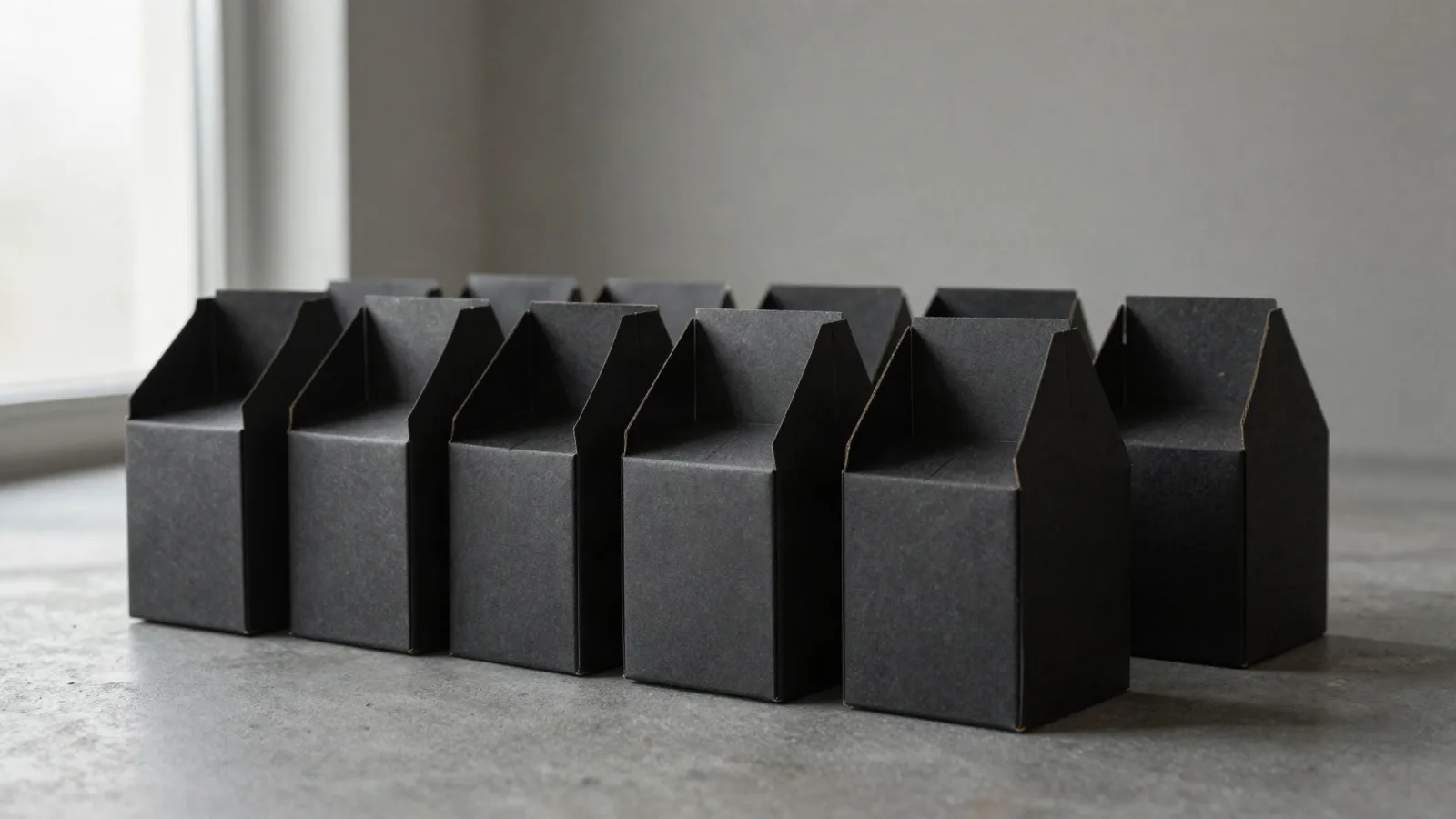




















































A straight tuck box is a folding carton whose top and bottom flaps tuck into the carton in the same direction. A dieline is the flat cutting template for that carton, showing the panels, scores, cuts, glue tab, and tuck areas before printing. For a wholesale project, choose the carton structure and paperboard together. Ink, coating, scoring, and folding can change how the stock and artwork read.
What is a straight tuck box?
A straight tuck box has a printed front panel and tuck closures that run the same way at both ends. It suits products that need a defined opening and a carton that ships flat before assembly. Start with the packed product dimensions, not a generic box label. We draw the dieline from those dimensions and send a digital proof before anything prints.
Check the assembled view before approving the flat file. Type too close to a score can break across a fold, and missing bleed can leave an unprinted sliver at a cut edge. Catch those problems in prepress.
What paper should tuck boxes be printed on?
White kraft or box board gives artwork a cleaner field for small type, logos, and broad color areas. Brown kraft and black kraft keep more paper character in the finished surface, so ink coverage and contrast need a closer check. Metallic, pearl, and holographic directions change how light hits the artwork. Textured paper and corrugated stock put more attention on surface and structure than on a flat print field.
Paperboard weight belongs in the quote. Ask for the paper direction and exact stock weight separately, then inspect both on the proof. A sample makes the choice easier when the artwork depends on a particular paper tone.
| Artwork priority | Paper direction to discuss | Proof check |
|---|---|---|
| Fine type and logos | White kraft or box board | Small text and edge contrast |
| Visible paper character | Brown kraft or black kraft | Ink coverage against the base tone |
| Reflective artwork | Metallic, pearl, or holographic | Color under direct light |
| Surface-led artwork | Textured paper or corrugated stock | Texture beside fine detail |
When should you compare a roll end front tuck box?
Compare a roll end front tuck box when the front tuck, rolling body, and side panels need a different relationship from a straight tuck carton. The structure changes the way the package opens and the way artwork travels around the body. Review roll end tuck front boxes as a separate dieline, not as a drop-in substitute.
Put the packed product and opening direction in the brief. A wide front image, a side-heavy copy plan, or a closure that must face the buyer can change which tuck style makes sense.
Which finishes work with folding panels?
Matte and gloss lamination change how light reads across a printed panel. Soft-touch changes the hand feel, while spot UV, foil, embossing, and debossing put attention on selected artwork. These treatments need room around scores, folds, glue tabs, and closure areas.
Mark each finish on the dieline. Then check the assembled carton, because a treatment that looks centered on the flat file can land on a side wall after folding. Keep important copy away from structural lines.
Which CPL products give a useful paper reference?
Use custom straight tuck boxes for the direct carton reference. Compare wine box packaging when the front panel and finish carry much of the presentation. Shoe box packaging gives another broad-surface comparison. For nearby tuck directions, review reverse tuck candle boxes and hair extension tuck boxes. The product pages frame the discussion; the approved quote sets the actual stock.
What should a straight tuck box wholesale request include?
A straight tuck box wholesale request should state the product dimensions, packed orientation, paper direction, finish, artwork status, quantity, and delivery destination. Include a photo or sketch if the product has a cap, handle, or irregular profile.
- Carton style and packed product
- Panel priorities and opening direction
- Paper direction and finish notes
- Artwork file or design status
- Quantity and delivery destination
Free design support covers the dieline and proof setup. Use wholesale custom packaging when the order discussion needs a larger quantity context.
What do straight tuck box orders cost and how long do they take?
The MOQ is 100 units. Pricing is from $0.49 per unit at volume, quoted to spec. Production is typically 8 to 10 business days after proof approval, plus delivery. Free US shipping and free design support are available. The $19.99 sample kit is credited toward the first order, so use it to compare paper and finish direction before approval.
Frequently Asked Questions
Is a straight tuck box suitable for wholesale orders?
Straight tuck boxes are suitable for wholesale orders when the packed product, paper direction, finish, quantity, and delivery details are defined before the quote. Custom Packaging Lane uses an MOQ of 100 units, with pricing from $0.49 per unit at volume, quoted to spec. Free US shipping is available.
Should I choose kraft or white paperboard?
Brown kraft keeps more paper character, while white kraft or box board gives artwork a cleaner field. Metallic, pearl, holographic, textured, and black kraft directions change the surface effect. The right choice depends on the artwork and finish, so confirm the exact stock weight in the quote and proof.
How does a roll end front tuck box differ?
A roll end front tuck box uses a different relationship between the front tuck, rolling body, and side panels than a straight tuck box. That changes the opening path and artwork layout. Review the roll end product as its own dieline, then approve the panel arrangement on the digital proof.
Can foil or spot UV cross a fold?
Foil, spot UV, embossing, and debossing should be mapped around scores, folds, glue tabs, and closures. Matte or gloss lamination changes the light on the panel. A finish can cross a fold only if the selected construction and artwork support it, so check the assembled carton before approval.
Which product page should I send with my brief?
Custom straight tuck boxes are the closest reference for the core style. Wine box packaging and shoe box packaging show broader print surfaces, while reverse tuck candle boxes and hair extension tuck boxes give nearby tuck examples. Use those pages to frame the request, then quote the actual stock and finish.












