




























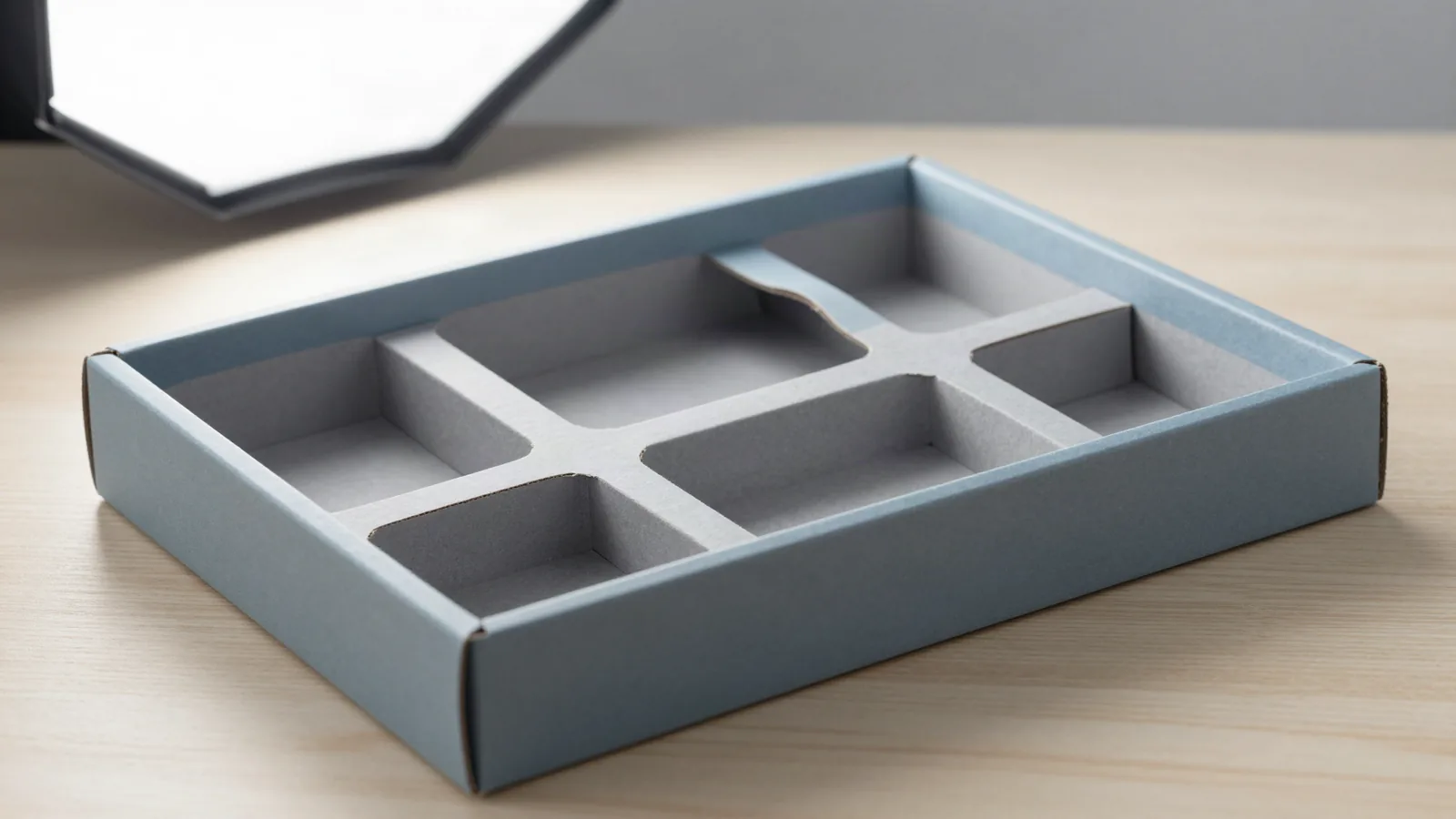




















































Custom packing foam is the shaped interior that cushions a product, separates components, controls movement, or creates a fitted presentation inside a box, case, or mailer. A cavity is the pocket cut into the foam; its shape follows the actual product envelope, not an outside photograph. The insert can be a pad, a fitted cavity, a layered interior, or a full support system. For outer-package planning, see custom packaging solutions.
What does custom packing foam need to protect?
Fragile corners, labels, handles, removable parts, and surfaces that should not rub decide where the foam walls and lift areas go. Record the product as length x width x depth, then separate product, cavity, and outer-package measurements. Use inside measurements for usable space. About 1/16 in, or 1.5 mm, is a common packaging tolerance reference, but the product, wrap, foam behavior, and outer box still control the fit.
Which foam materials are common for packaging interiors?
EVA and polyethylene foam are common starting points for firmer fitted interiors. Polyurethane foam is often considered when a softer, more compressible cushion is appropriate. Closed-cell and open-cell foams respond differently under pressure, so the brief should identify the product surface, cavity depth, handling pressure, and desired wall firmness.
| Foam decision | Common trade reference | What to check |
|---|---|---|
| Material family | EVA or polyethylene foam | Firmness, surface contact, and cavity support |
| Softer cushion | Polyurethane foam | Compression behavior and product protection |
| Fabrication route | Die-cutting or CNC routing | Shape repeatability and cavity detail |
| Fit convention | Length x width x depth, inside measurements | Product, insert, and outer-package relationship |
Should the insert be die-cut, routed, or layered?
Die-cutting suits repeatable shapes and established insert layouts. CNC routing is computer-controlled cutting that can follow a deeper or more detailed contour. Layered foam creates steps, removable top levels, or separate zones for components. See custom foam box inserts for a fitted interior reference. A bottle layout can be compared through custom woozy bottle boxes, while smaller component packaging may fit custom vial boxes. For presentation use, see custom votive candle boxes.
How should the cavity hold and release the product?
Retention and access are separate design decisions. A tight cavity can control movement, but the user still needs a practical way to remove the item. Show the product orientation, lift direction, finger access, layered construction, and defined lift area. Include caps, handles, labels, accessories, and any wrap or bag that sits between the product and the foam. Check placement and removal in the same order used during packing.
Which outer package fits the foam insert?
Rigid chipboard is stiff board wrapped with printed paper. A common presentation-box construction uses 1.5 to 3 mm chipboard wrapped in 100 to 157 gsm art paper. Paperboard cartons can use SBS, C1S, or C2S stock in the 12 to 24 pt range. Offset CMYK, matte or gloss lamination, soft-touch, foil stamping, embossing, and debossing belong to the exterior brief. Set the outer size after the foam cavity, not before.
What should a packing-foam quote brief include?
The brief should let someone draw the cavity without guessing which product surface, accessory, or lift path matters. Send:
- Product length, width, depth, packed envelope, wrap, labels, caps, handles, and accessories.
- Foam family, firmness direction, cavity depth, wall thickness, and surface-contact concerns.
- Die-cutting, CNC routing, layered construction, or another fabrication route.
- Product orientation, retention points, lift access, loading order, and outer-package dimensions.
- Quantity, artwork status, shipping destination, and the box, case, sleeve, or mailer that holds the insert.
Custom Packaging Lane quotes packing foam to spec from a 100-unit minimum. Pricing is from $0.49 per unit at volume, quoted to spec. Production is typically 8 to 10 business days after proof approval, plus delivery. Free US shipping and free design support are available, and the free dieline can map the cavity and outer package. The $19.99 sample kit is credited to the first order.
Frequently Asked Questions
Can packing foam fit an irregular product?
Yes, custom packing foam can follow an irregular product when the drawing or sample shows the actual envelope, handles, labels, caps, and protrusions. The cavity should protect contact surfaces while leaving a lift path. Measure the packed product, including wrap or accessories, rather than tracing only its largest outside silhouette.
How do open-cell and closed-cell foam differ?
Open-cell and closed-cell foams respond differently when compressed. Material selection should consider firmness, recovery, surface contact, cavity depth, and handling pressure. EVA and polyethylene are common starting points for firmer fitted inserts, while polyurethane is often considered for a softer cushion. A fit sample shows whether the chosen behavior suits removal and retention.
Should the foam insert be sized before the box?
Yes. Size the foam around the actual product and access path before finalizing the outer box. The insert's walls, layers, lift areas, and cavity depth determine usable interior space. Then set the rigid box, paperboard carton, sleeve, mailer, or case around the assembled interior, with inside dimensions clearly separated from outside dimensions.
Can one insert hold several components?
Yes. A layered or multi-cavity insert can separate components and assign each item a defined position. Show the loading and removal order, the wall between cavities, and the access point for each component. A shared insert should be checked with every item in place, since one tall or loose part can change how the rest of the package closes.
What should I inspect in a foam fit sample?
Inspect the cavity depth, product orientation, wall contact, lift access, wrap clearance, accessory positions, and the way the outer package closes. Look for rattling, pinching, scuffing, or a lid that compresses the insert. Repeat the actual placement and removal sequence before releasing the final cavity drawing.












