




























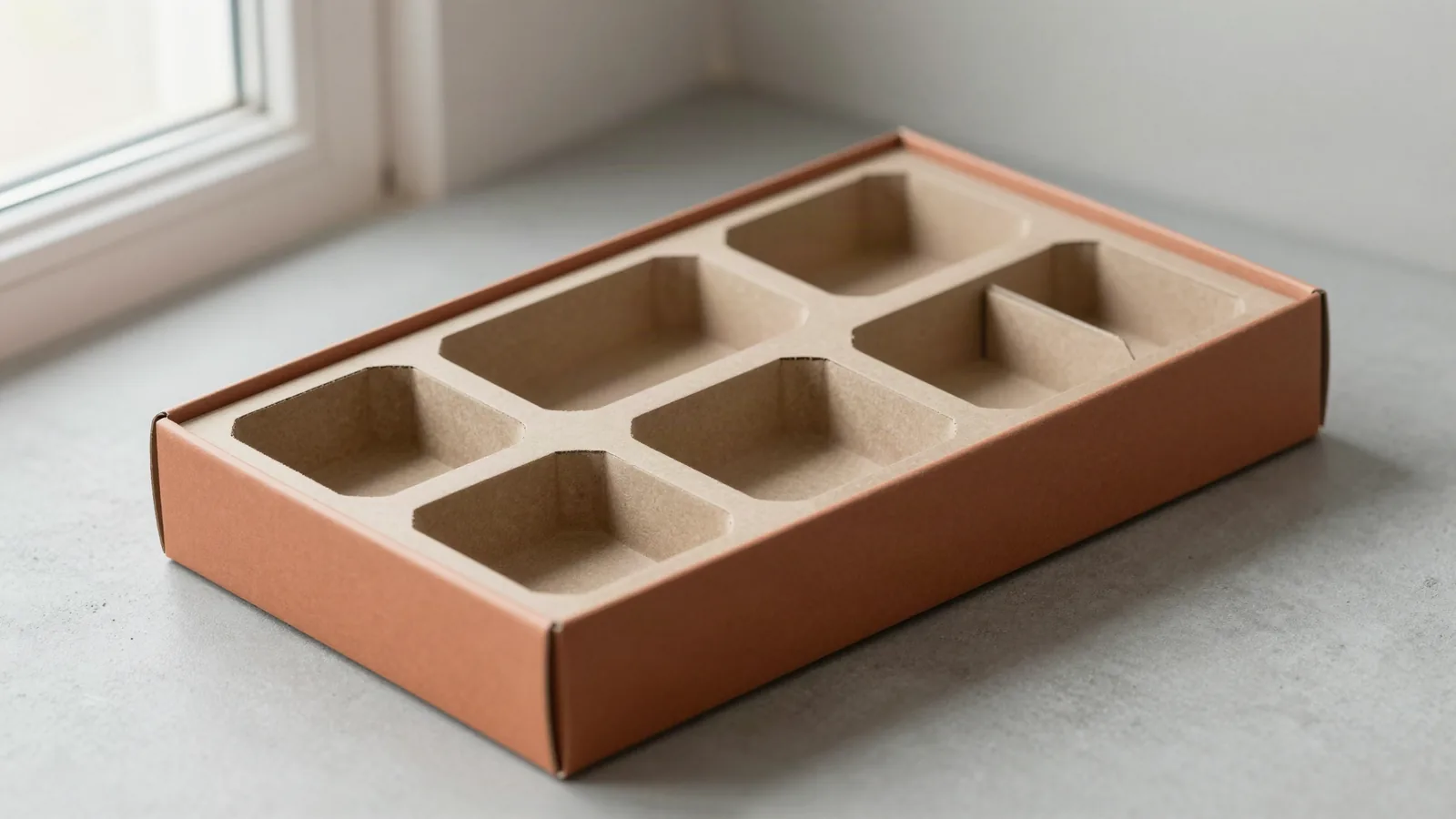




















































How do custom foam cutouts hold a product securely?
A foam cutout is an insert routed or cut with a shaped cavity that locates the product inside its box. The cavity follows the product's length, width, depth, orientation, protrusions, and fragile areas. One insert can hold a single item, several pieces, or layers at different heights. The fit has two jobs: control movement during handling and leave enough finger access for removal.
Measure the product first. Box dimensions are normally written as length x width x depth, using inside measurements for the fit. About 1/16 in (1.5 mm) is a common planning tolerance, although the working fit depends on the insert material, cavity shape, product surface, and outer structure. A tight-looking drawing can still fail if the lid presses on a tall feature or the cutout stops a hand from reaching the product.
Which foam surface and insert layout fit the product?
Contact pressure is the first material decision. A firmer closed-cell surface gives a more defined hold around a product, while a softer surface can be gentler around a delicate finish. The practical choice also depends on compression, surface texture, cleanup needs, and how much movement the cavity must stop.
Layered inserts separate those jobs. A shaped top layer can locate the item, while a deeper support layer carries the lower section. For several components, show the loading order and the space between cavities. An insert cut to the exact product size may stop rattling, but it can become awkward to unload when there is no finger notch or access channel.
| Decision | Common reference | Check before proof approval |
|---|---|---|
| Cavity plan | Single, nested, or layered layout | Contact points, product orientation, and finger access |
| Foam surface | Firmer closed-cell or softer contact surface | Compression, texture, cleanup, and product finish |
| Rigid wrap | Chipboard 1.5 to 3 mm, wrapped in 100 to 157 gsm art paper | Wrap direction, edge coverage, and panel alignment |
| Visible opening | PET window, commonly 0.2 to 0.3 mm | Window edge, cavity lip, and lid clearance |
Which box structure works with a foam cutout?
A two-piece rigid box gives the insert a separate base and lid, so the opening can reveal the product in one lift. A drawer or slide uses a sleeve and tray, which puts the pull direction and front edge into the fit discussion. A magnetic flap changes the hinge and closure area. Folding structures such as a straight tuck end or auto-lock bottom can suit a lighter insert and a simpler closure.
The outside shell must leave room for the assembled insert. Check the foam height against the lid, the cavity edge against the folds, and the product against any window patch. If the package will sit inside another shipper, include that outer layer in the brief. The insert and the box are one assembled fit.
How should printing and finishes be planned around the cutout?
Offset CMYK is a common reference for detailed printed shells, while digital printing can suit short-run artwork changes when the selected process supports them. Matte or gloss lamination changes surface reflection. Soft-touch changes hand feel. Spot UV can isolate a logo or opening. Foil stamping, embossing, and debossing add a raised or recessed detail, but those effects belong away from scores, folds, seams, and cavity edges.
For related catalog formats, custom foam box inserts cover the insert question, custom woozy bottle boxes show a tall bottle format, custom votive candle boxes provide a compact presentation reference, and custom vial boxes show a narrow product layout.
What should the foam packaging proof show?
The proof should make the assembled fit readable in one place: cavity outline, product orientation, inside measurements, shell panels, closure path, print areas, and finish callouts. Send product dimensions and the existing artwork together. Low-resolution art, RGB color converted for press, missing bleed, and type set too close to a score are easier to fix on the proof than after the run is on a pallet.
- Product length, width, depth, orientation, protrusions, and fragile areas.
- Cavity depth, insert layers, hand-clearance areas, and accessory placement.
- Shell structure, lid clearance, opening direction, window choice, and closure path.
- Print coverage, logo position, finish zones, artwork status, and any existing sample.
Custom Packaging Lane quotes to spec from a 100-unit minimum, with pricing from $0.49 per unit at volume, quoted to spec. Production is typically 8 to 10 business days after proof approval, plus delivery. Free US shipping, free design support, and a free dieline are available. Order the $19.99 sample kit, credited to the first order, before you lock the cavity and finish direction. See custom packaging design for the broader design brief.
Frequently Asked Questions
What information is needed to size a foam cutout?
Sizing a foam cutout starts with the product's length, width, depth, orientation, protrusions, fragile points, and closure direction. State where fingers need access and whether the item needs a firm hold or softer contact. Inside measurements are normally written as length x width x depth, with about 1/16 in (1.5 mm) used as a planning tolerance.
Can a foam cutout fit inside a rigid box?
A foam cutout can fit a two-piece rigid box, drawer or slide, magnetic flap, folding carton, or mailer when the assembled clearances are drawn together. The box controls the opening, while the insert controls product contact. Check cavity depth, lid clearance, insert movement, and the loading path before approving the structure.
How do I choose a foam surface for a product?
A firmer closed-cell surface gives defined support around a product, while a softer surface can suit a delicate finish. The choice also depends on compression, texture, cleanup, and the amount of movement the cavity must control. Compare the contact areas and removal path, not just the appearance of the foam.
Can the product remain visible inside the package?
A foam cutout can include an open reveal or a PET window when the product should be visible without removing the insert. PET windows commonly use 0.2 to 0.3 mm film. Check the window edge, cavity lip, print panel, and lid movement together so the viewing area remains useful after assembly.
What should a foam packaging proof show?
A foam packaging proof should show the cavity outline, product orientation, shell panels, closure path, inside measurements, print areas, and finish callouts. It should also show where the insert sits in the assembled box. Check the real product against the drawing, especially around protrusions, scores, lid clearance, and finger access, before production begins.












